What the lesson covers
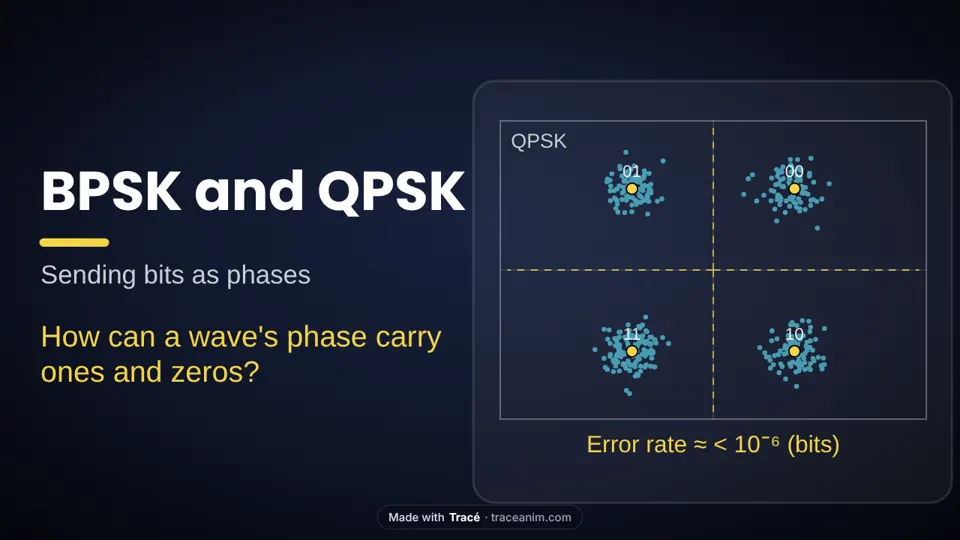
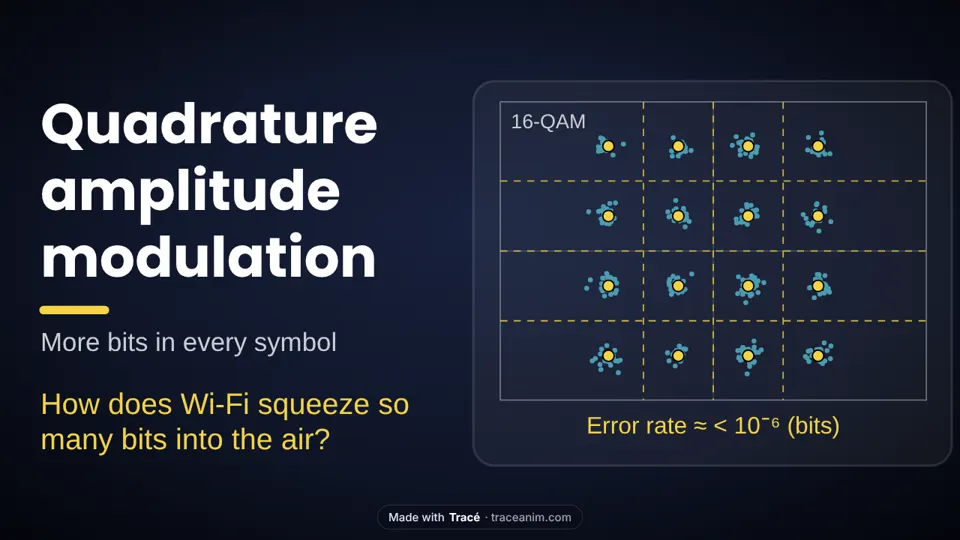
The bit error rate is the fraction of bits a receiver gets wrong; Eb/N0 is the energy per bit compared with the noise. Students watch noise blur a constellation, read how fast BPSK errors fall with Eb/N0 and convert SNR to Eb/N0.
The slides, one by one
Every slide is built click by click: text, formulas and pictures come in one step at a time, so the class follows the reasoning instead of reading ahead. Graphs with sliders can be dragged live while you present.
Questions teachers ask
What is Eb/N0?
The energy per bit divided by the noise power spectral density. It equals SNR × B ÷ Rb, so it lets you compare modulation schemes fairly: BPSK needs about 9.6 dB for a bit error rate of 10⁻⁵.
Are these slides really free?
Yes. Watch them on this page or present them full screen with no account. Making your own copy to edit is free too.
Can I change the slides before my lesson?
Yes. Press "Make my own copy" and the deck becomes one of your projects in the Tracé editor, where you can change the text, the numbers, the colours or the order of the clicks.
Do they work on a classroom projector or an interactive whiteboard?
Yes. They run in the browser on any laptop, so anything that shows your screen works. Press the right arrow or click to go to the next step.