What the lesson covers
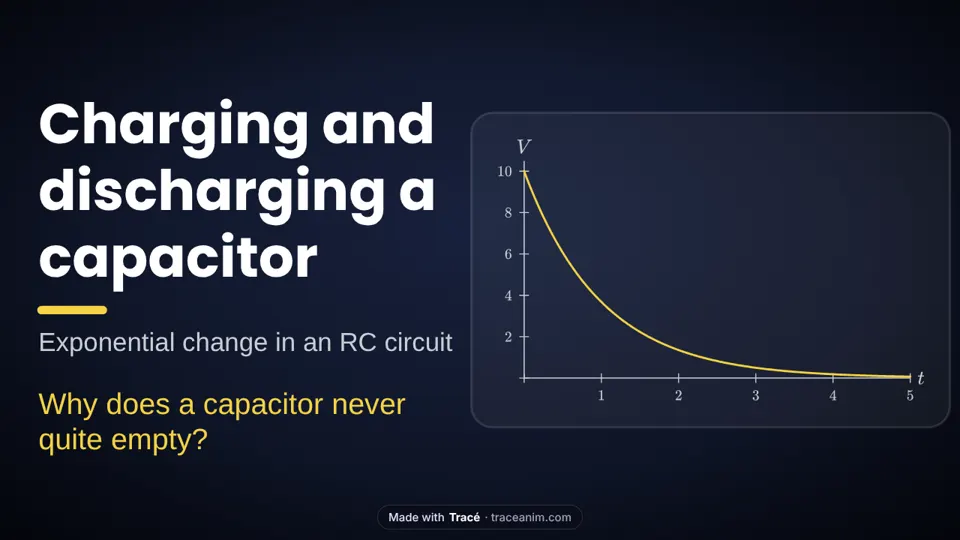
Two metal plates separated by an insulator store charge when connected to a battery. Students meet Q = CV, see why the energy stored is the area under the Q–V graph and work out the energy in a 470 μF capacitor.
The slides, one by one
1 Capacitors
Storing charge on two plates
How does a camera flash release so much energy so fast?
2 Charge stored is proportional to the voltage
Live graph: y = ((0.47))·(x)
3 The energy is the area under the Q–V graph
Live graph: y = 0.47·x
A triangle: half base times height
4 Charge and energy in a capacitor
A 470 μF capacitor is charged to 12 V. Find the charge stored and the energy stored.
→ Q = CV, then E = ½CV²
It stores 5.64 mC of charge and about 34 mJ of energy
5 Quick check
A 100 μF capacitor at 10 V stores a charge of…
Show the answer
1 mC
Q = CV = 100 × 10⁻⁶ × 10 = 1 × 10⁻³ C = 1 mC.
6 What to remember
A capacitor stores charge on plates
Energy: area under the Q–V graph
Challenge: Doubling the voltage: what happens to the charge and to the energy?
Every slide is built click by click: text, formulas and pictures come in one step at a time, so the class follows the reasoning instead of reading ahead. Graphs with sliders can be dragged live while you present.
Make your own version with AIChange the level, the numbers or the language: type the topic and get a new deck that moves in about 30 seconds. Free, no account needed.
Questions teachers ask
How much energy does a capacitor store?
E = ½CV² = ½QV. A 470 μF capacitor at 12 V stores Q = 5.64 mC and about 34 mJ of energy.
Are these slides really free?
Yes. Watch them on this page or present them full screen with no account. Making your own copy to edit is free too.
Can I change the slides before my lesson?
Yes. Press "Make my own copy" and the deck becomes one of your projects in the Tracé editor, where you can change the text, the numbers, the colours or the order of the clicks.
Do they work on a classroom projector or an interactive whiteboard?
Yes. They run in the browser on any laptop, so anything that shows your screen works. Press the right arrow or click to go to the next step.