What the lesson covers
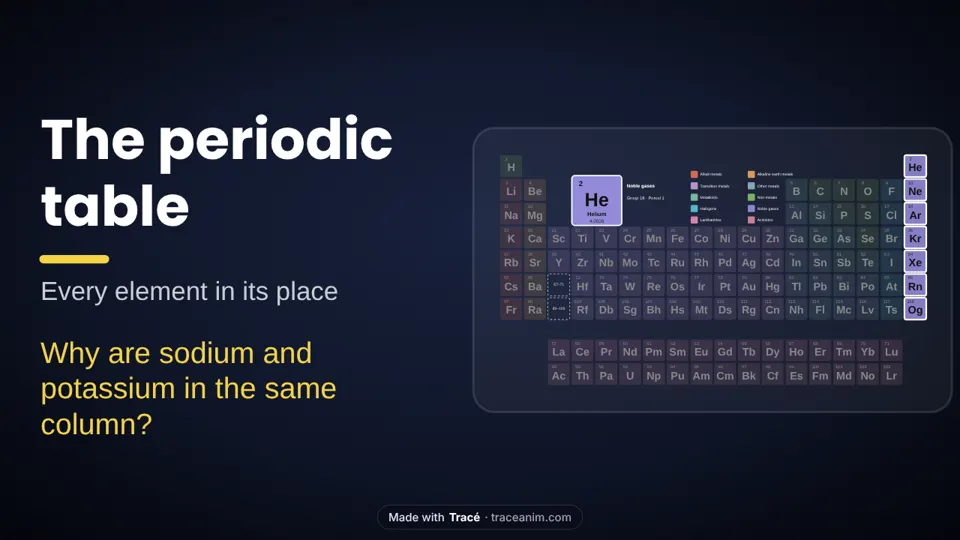
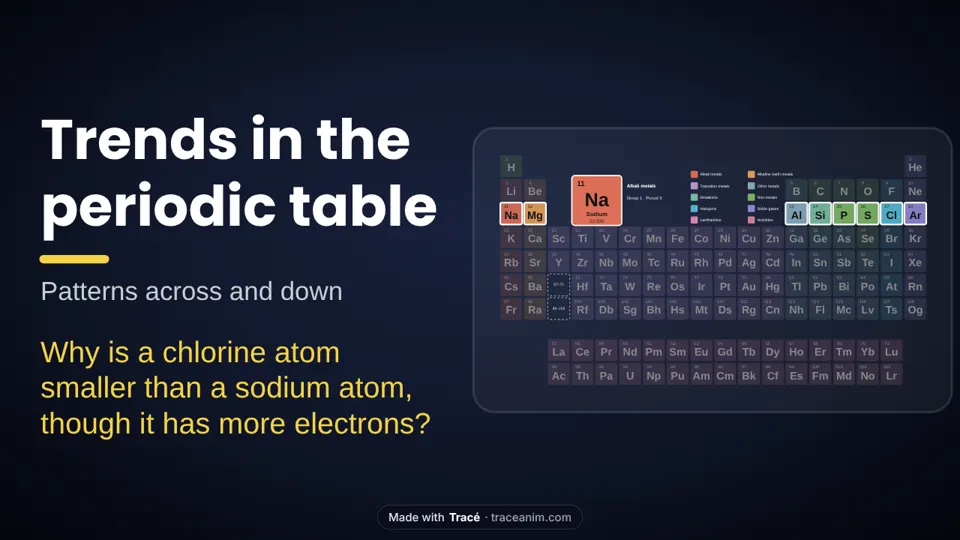
Elements in a group have the same number of outer electrons and react in similar ways. Students compare the alkali metals, the halogens and the noble gases, see opposite reactivity trends and predict the melting point of rubidium.
The slides, one by one
1 Groups of the periodic table
Families of elements
Why does potassium react more violently with water than sodium?
2 Down group 1, melting points fall
Melting point: Li 181, Na 98, K 63 °C
Reactivity rises: the outer electron is lost more easily
3 Halogens and noble gases sit side by side
Group 7: halogens
- Seven outer electrons
- Less reactive going down
\mathrm{Cl_2 + 2KBr \to 2KCl + Br_2}
Group 0: noble gases
- Full outer shells
- Almost unreactive
- Helium, neon, argon
The number of outer electrons decides how a group reacts
4 Predicting the melting point of rubidium
Melting points down group 1: Li 181 °C, Na 98 °C, K 63 °C. Predict the melting point of rubidium, the next element.
→ Follow the pattern of the drops
Rubidium should melt at about 40 °C (it really melts at 39 °C)
5 Quick check
Which halogen is the most reactive?
- Fluorine
- Chlorine
- Bromine
- Iodine
Show the answer
Fluorine
Fluorine is smallest, so it attracts an extra electron most strongly.
6 What to remember
Same group: same outer electrons
Group 1: more reactive going down
Group 7: less reactive going down
Group 0: full shells, unreactive
Challenge: Would you expect astatine to displace iodine from potassium iodide?
Every slide is built click by click: text, formulas and pictures come in one step at a time, so the class follows the reasoning instead of reading ahead. Graphs with sliders can be dragged live while you present.
Make your own version with AIChange the level, the numbers or the language: type the topic and get a new deck that moves in about 30 seconds. Free, no account needed.
Questions teachers ask
Why does reactivity increase down group 1?
The outer electron is further from the nucleus and more shielded, so it is lost more easily. In group 7 reactivity falls going down because an electron is gained less easily.
Are these slides really free?
Yes. Watch them on this page or present them full screen with no account. Making your own copy to edit is free too.
Can I change the slides before my lesson?
Yes. Press "Make my own copy" and the deck becomes one of your projects in the Tracé editor, where you can change the text, the numbers, the colours or the order of the clicks.
Do they work on a classroom projector or an interactive whiteboard?
Yes. They run in the browser on any laptop, so anything that shows your screen works. Press the right arrow or click to go to the next step.