What the lesson covers
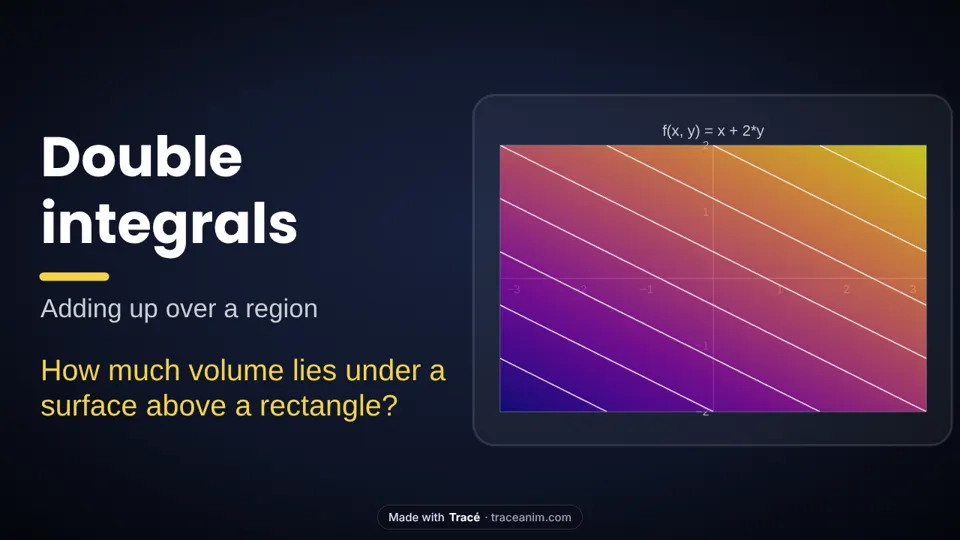
Contour maps show a function of two variables as a landscape. Students fix y to slice it, differentiate in x, and evaluate both partial derivatives of x³ + 2xy² − y at (1, 2).
The slides, one by one
1 Partial derivatives
Slopes in more than one direction
On a hill, how steep is it going east, and going north?
2 Hold y fixed and differentiate in x
Live graph: y = 2·x² + 6
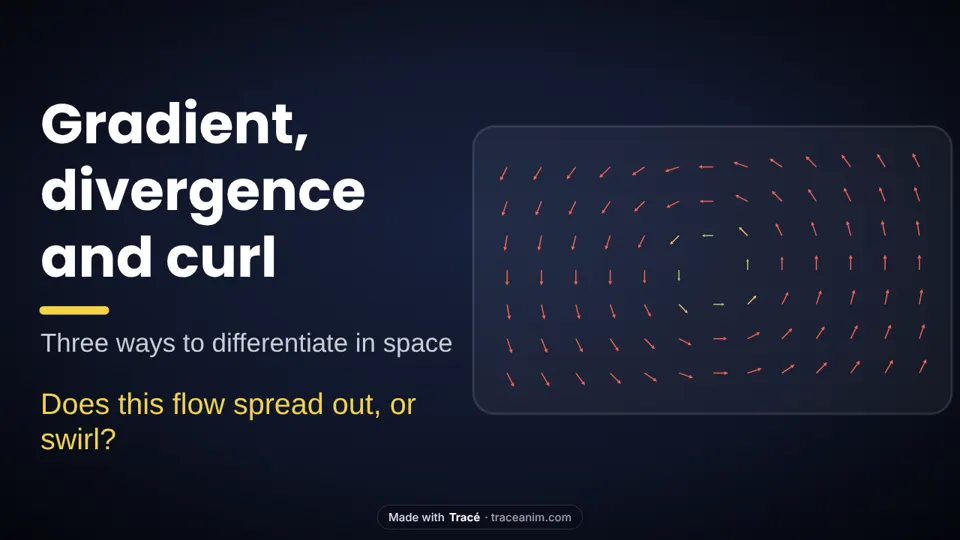
3 The gradient vector points straight uphill
It crosses the contours at right angles
4 Both partial derivatives at (1, 2)
For f(x, y) = x³ + 2xy² − y, find ∂f/∂x and ∂f/∂y at (1, 2).
→ Treat the other variable as a constant
∂f/∂x = 11 and ∂f/∂y = 7 at (1, 2)
5 Quick check
Show the answer
Treat y as a constant: the chain rule gives y · e^(xy).
6 What to remember
Each is the slope of a slice
Challenge: Find f_xy for f = x²y³.
Every slide is built click by click: text, formulas and pictures come in one step at a time, so the class follows the reasoning instead of reading ahead. Graphs with sliders can be dragged live while you present.
Make your own version with AIChange the level, the numbers or the language: type the topic and get a new deck that moves in about 30 seconds. Free, no account needed.
Questions teachers ask
What is a partial derivative?
The derivative of f(x, y) with respect to one variable while the other is held constant: for x²y + 3y, ∂f/∂x = 2xy and ∂f/∂y = x² + 3.
Are these slides really free?
Yes. Watch them on this page or present them full screen with no account. Making your own copy to edit is free too.
Can I change the slides before my lesson?
Yes. Press "Make my own copy" and the deck becomes one of your projects in the Tracé editor, where you can change the text, the numbers, the colours or the order of the clicks.
Do they work on a classroom projector or an interactive whiteboard?
Yes. They run in the browser on any laptop, so anything that shows your screen works. Press the right arrow or click to go to the next step.