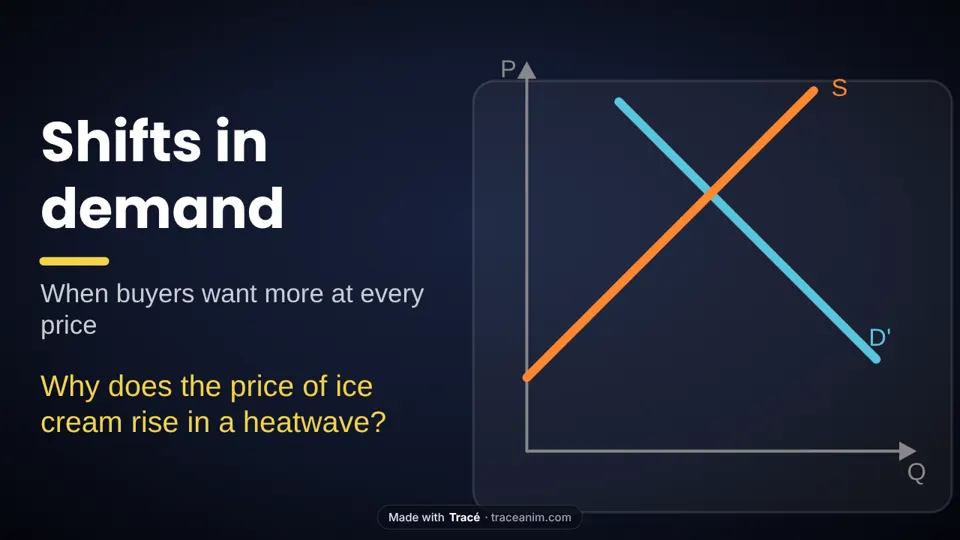
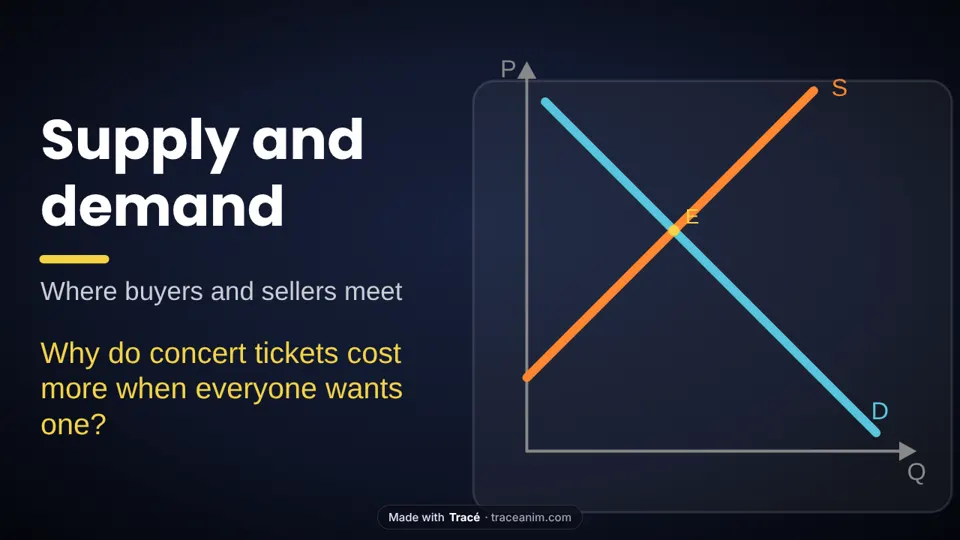
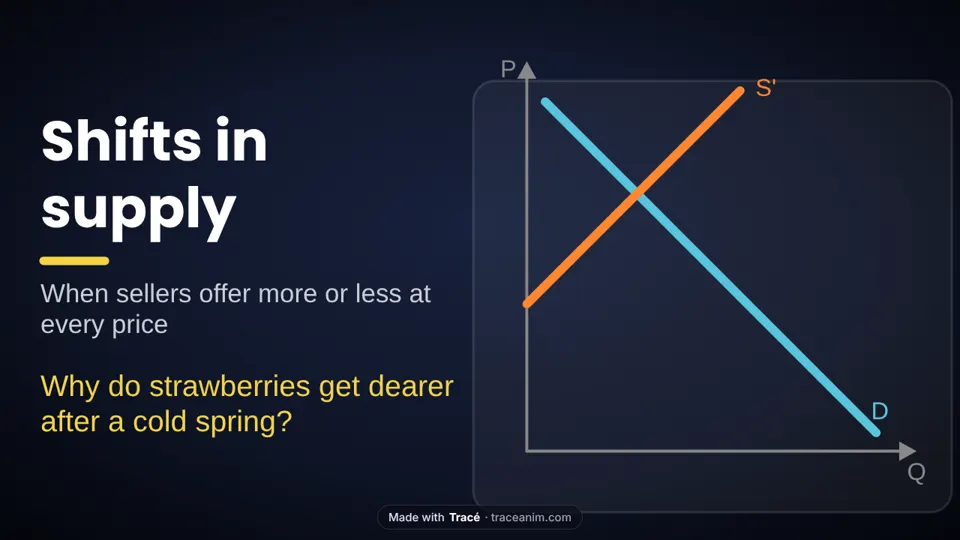
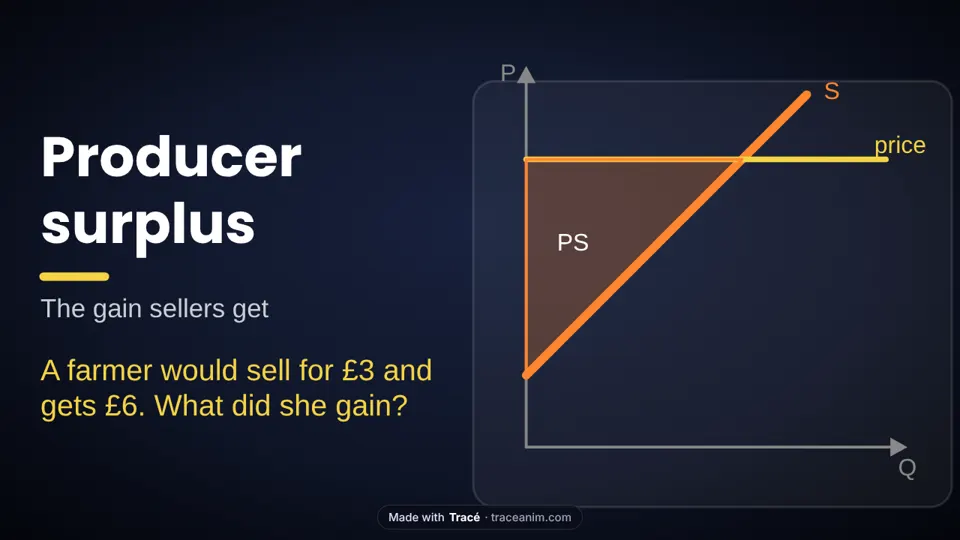
What the lesson covers
Price elasticity of demand measures how strongly buyers react to a price change. Students tilt a demand curve with a slider, sort goods into elastic and inelastic, and calculate an elasticity from percentage changes.
The slides, one by one
1 Price elasticity of demand
How strongly buyers react to price
Why can petrol stations raise prices more easily than cinemas?
2 A steeper demand curve reacts less to price
\text{PED} = \dfrac{\%\,\Delta Q_d}{\%\,\Delta P}
y = 10 - b \left(x - 4\right) - 4
Live graph: y = ((10)-(((1))·(((x)-(4)))))-(4)
\textsf{Drag }b\textsf{: steep means inelastic}
3 Substitutes make demand elastic
Elastic: |PED| > 1
- Many substitutes
- Luxuries
- Big share of income
Inelastic: |PED| < 1
- Few substitutes
- Necessities like petrol
- Habits and short run
The easier it is to switch, the more elastic
4 Elasticity of cinema tickets
A ticket rises from £8.00 to £8.80 and weekly sales fall from 500 to 400. Find the PED.
→ Percentage change in quantity ÷ percentage change in price
\%\Delta P = \dfrac{0.80}{8.00} \times 100 = 10\%
\%\Delta Q = \dfrac{-100}{500} \times 100 = -20\%
\text{PED} = \dfrac{-20}{10} = -2
PED = −2: demand is elastic
5 Quick check
Price rises by 20% and quantity demanded falls by 5%. The PED is…
- −4, elastic
- −0.25, elastic
- −0.25, inelastic
- −4, inelastic
Show the answer
−0.25, inelastic
−5 ÷ 20 = −0.25; its size is below 1, so demand is inelastic.
6 What to remember
\text{PED} = \%\Delta Q_d \div \%\Delta P
It is negative: price and quantity move apart
|PED| > 1 elastic, < 1 inelastic
Substitutes make demand more elastic
Challenge: Why is demand for one brand of petrol more elastic than for petrol in general?
Every slide is built click by click: text, formulas and pictures come in one step at a time, so the class follows the reasoning instead of reading ahead. Graphs with sliders can be dragged live while you present.
Make your own version with AIChange the level, the numbers or the language: type the topic and get a new deck that moves in about 30 seconds. Free, no account needed.
Questions teachers ask
How do you calculate price elasticity of demand?
Divide the percentage change in quantity demanded by the percentage change in price. If a 10% price rise cuts sales by 20%, PED = −20 ÷ 10 = −2, so demand is elastic.
Are these slides really free?
Yes. Watch them on this page or present them full screen with no account. Making your own copy to edit is free too.
Can I change the slides before my lesson?
Yes. Press "Make my own copy" and the deck becomes one of your projects in the Tracé editor, where you can change the text, the numbers, the colours or the order of the clicks.
Do they work on a classroom projector or an interactive whiteboard?
Yes. They run in the browser on any laptop, so anything that shows your screen works. Press the right arrow or click to go to the next step.