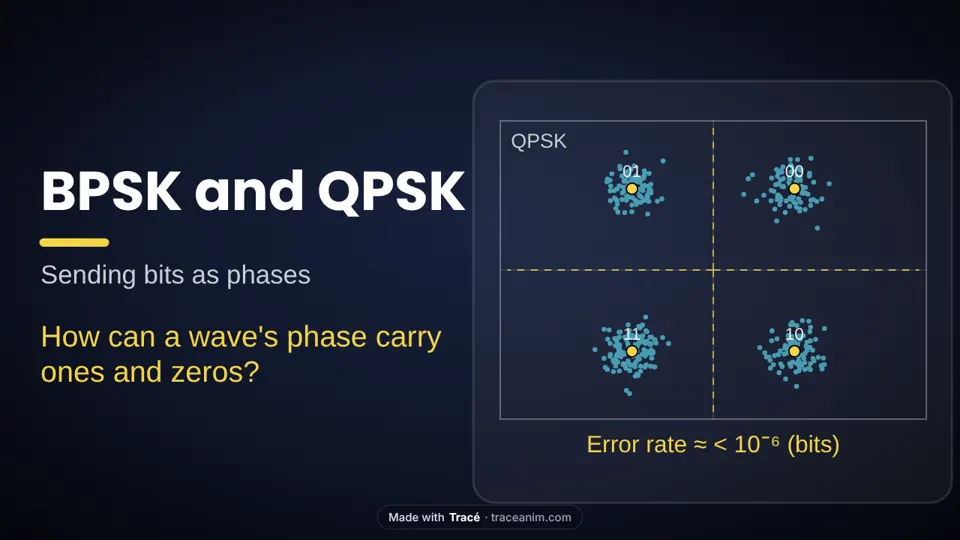
What the lesson covers
Sharp rectangular pulses need a lot of bandwidth; smooth pulses spread in time and blur into each other. Students see how Nyquist pulses cross zero at every other symbol time, drag the roll-off factor of a raised-cosine pulse and work out the bandwidth of a link.
The slides, one by one
1 Pulse shaping and raised cosine
Pulses that do not blur together
How can pulses overlap and still be read without errors?
2 Nyquist pulses are zero at every other symbol time
Overlapping pulses: no intersymbol interference
\textsf{Sample at }t = nT\textsf{: only one pulse counts}
3 A bigger roll-off makes the tails die faster
B_{RF} = (1 + \alpha)\,R_s
y = \frac{\frac{\sin\left(\pi x\right)}{\pi x} \cos\left(\pi a x\right)}{1 - \left(2 a x\right)^{2}}
Live graph: y = (((sin(((pi)·(x))))/(((pi)·(x))))·(cos((((pi)·((0.5)))·(x)))))/(((1)-(((((2)·((0.5)))·(x)))··(2))))
\textsf{Drag }a\textsf{ (roll-off α, 0 to 1)}
4 Bandwidth of a QPSK link
A QPSK link sends 1 million symbols per second with raised-cosine pulses, α = 0.25. Find the bit rate and the passband bandwidth.
→ QPSK carries 2 bits per symbol; passband B = (1 + α)Rs
R_b = 2 \times 10^6 = 2\ \text{Mb/s}
B_{\text{baseband}} = 1.25 \times 0.5\ \text{MHz} = 625\ \text{kHz}
B_{\text{passband}} = 1.25 \times 1\ \text{MHz} = 1.25\ \text{MHz}
2 Mb/s in a 1.25 MHz radio channel
5 Quick check
Rs = 10 Msymbol/s and α = 0.2. The passband bandwidth is…
Show the answer
12 MHz
B = (1 + 0.2) × 10 MHz = 12 MHz.
6 What to remember
ISI: pulses blurring into each other
Nyquist pulses: zero at other symbol times
Roll-off α: more bandwidth, shorter tails
B = (1 + \alpha) R_s\textsf{ in passband}
Challenge: Why is α = 0 (a perfect sinc pulse) not used in real systems?
Every slide is built click by click: text, formulas and pictures come in one step at a time, so the class follows the reasoning instead of reading ahead. Graphs with sliders can be dragged live while you present.
Make your own version with AIChange the level, the numbers or the language: type the topic and get a new deck that moves in about 30 seconds. Free, no account needed.
Questions teachers ask
What bandwidth does a raised-cosine pulse need?
At a symbol rate Rs and roll-off α, the baseband bandwidth is (1 + α)Rs/2 and the passband bandwidth is (1 + α)Rs. With Rs = 1 Msymbol/s and α = 0.25 the passband needs 1.25 MHz.
Are these slides really free?
Yes. Watch them on this page or present them full screen with no account. Making your own copy to edit is free too.
Can I change the slides before my lesson?
Yes. Press "Make my own copy" and the deck becomes one of your projects in the Tracé editor, where you can change the text, the numbers, the colours or the order of the clicks.
Do they work on a classroom projector or an interactive whiteboard?
Yes. They run in the browser on any laptop, so anything that shows your screen works. Press the right arrow or click to go to the next step.