Open the editor

Physics · Middle school

Refraction of Light Slides

Free animated slides, ready to teach: 6 slides where every step appears on a click and the diagrams move. Play them right here, present them full screen, or copy them into your account to edit.

A real Tracé deck playing in your browser. No account needed.

What the lesson covers

A straw looks bent in water because light changes speed and direction at the surface. The class sees rays bend towards the normal in glass and finds the refractive index from the speed of light.

The slides, one by one

1 Refraction of light

Why light bends

Why does a straw look bent in a glass of water?

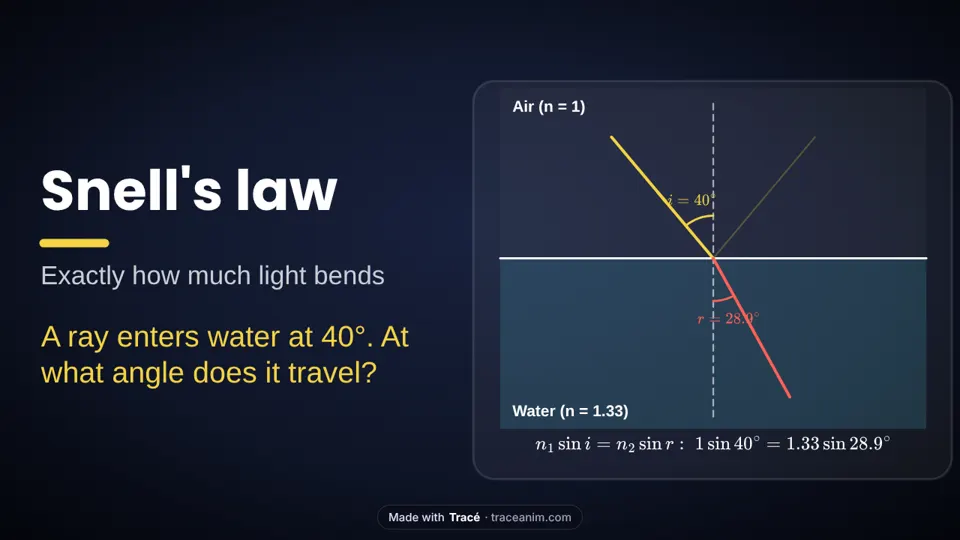
2 Light bends towards the normal entering glass

It slows down in glass

Steeper rays bend more

3 Denser materials slow light more

n=cvn = \dfrac{c}{v}
Bigger n: slower light, morebending\begin{aligned}&\textsf{Bigger }n\textsf{: slower light, more}\\ &\textsf{bending}\end{aligned}

4 The refractive index of a plastic

Light travels at 1.875 × 10⁸ m/s in a plastic. Find its refractive index (c = 3.0 × 10⁸ m/s).

→ n = c / v

n=3.0×1081.875×108n = \dfrac{3.0 \times 10^8}{1.875 \times 10^8}
n=1.6n = 1.6

The refractive index of the plastic is 1.6

5 Quick check

Light passes from glass into air. It bends…

  • towards the normal
  • straight back
  • away from the normal
  • not at all
Show the answer

away from the normal

It speeds up in air, so it bends away from the normal.

6 What to remember

Refraction: a change of speed bends light

Into a denser material: towards the normal

Out of it: away from the normal

n=cvn = \frac{c}{v}

Challenge: Why does a swimming pool look shallower than it really is?

Every slide is built click by click: text, formulas and pictures come in one step at a time, so the class follows the reasoning instead of reading ahead. Graphs with sliders can be dragged live while you present.

Make your own version with AIChange the level, the numbers or the language: type the topic and get a new deck that moves in about 30 seconds. Free, no account needed.

Questions teachers ask

Why does light bend when it enters glass?

It slows down from about 300 000 km/s to about 200 000 km/s, and the change of speed changes its direction.

Are these slides really free?

Yes. Watch them on this page or present them full screen with no account. Making your own copy to edit is free too.

Can I change the slides before my lesson?

Yes. Press "Make my own copy" and the deck becomes one of your projects in the Tracé editor, where you can change the text, the numbers, the colours or the order of the clicks.

Do they work on a classroom projector or an interactive whiteboard?

Yes. They run in the browser on any laptop, so anything that shows your screen works. Press the right arrow or click to go to the next step.