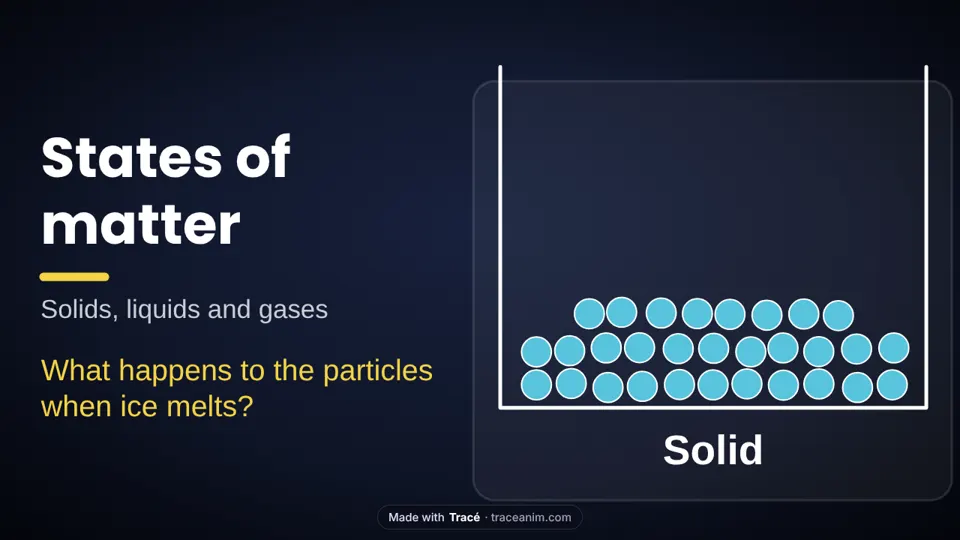
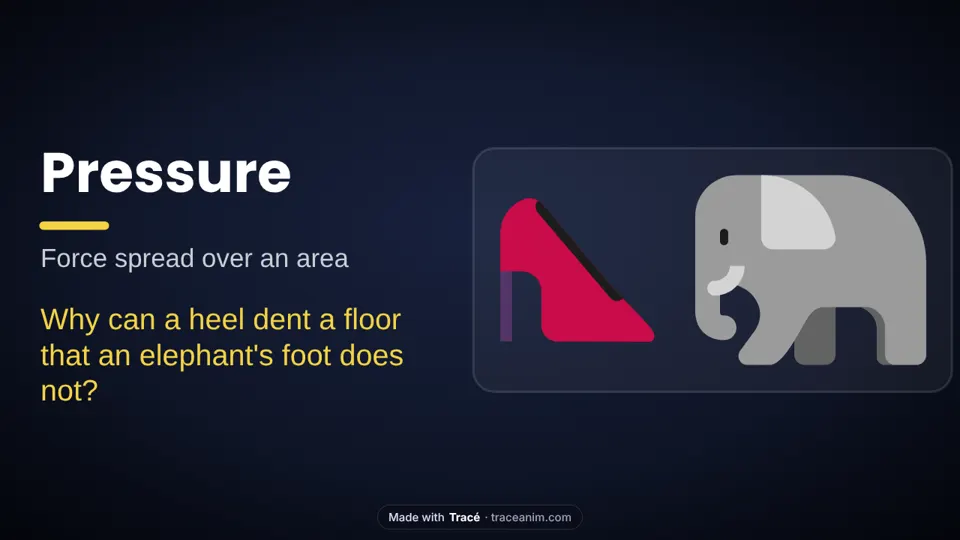
What the lesson covers
Fast particles hitting the walls of a container make gas pressure. Heating the gas speeds them up, and students use p/T = constant in kelvin to find the pressure in a warm tyre.
The slides, one by one
1 The particle model of gases
Tiny particles, always moving
Why does a balloon get bigger in the sun?
2 Gas pressure comes from particles hitting walls
Each collision pushes on the wall
More hits per second: more pressure
3 Pressure is proportional to kelvin temperature
Live graph: y = 100·x/300
At 0 K the particles stop
4 The pressure in a warm tyre
A tyre is at 200 kPa at 17 °C. After a drive the air is at 46 °C. Find the new pressure (volume fixed).
→ Kelvin, then p₁/T₁ = p₂/T₂
The pressure rises to 220 kPa
5 Quick check
A sealed can of gas is cooled. Its pressure…
- decreases
- increases
- stays the same
- becomes zero
Show the answer
decreases
Slower particles hit the walls less often and less hard.
6 What to remember
Gas particles move fast and randomly
Pressure: collisions with the walls
Hotter: faster, more pressure
Challenge: What is 0 K, and why can nothing be colder?
Every slide is built click by click: text, formulas and pictures come in one step at a time, so the class follows the reasoning instead of reading ahead. Graphs with sliders can be dragged live while you present.
Make your own version with AIChange the level, the numbers or the language: type the topic and get a new deck that moves in about 30 seconds. Free, no account needed.
Questions teachers ask
Why does gas pressure rise when it is heated?
The particles move faster, so they hit the walls more often and harder. At fixed volume, pressure is proportional to the kelvin temperature.
Are these slides really free?
Yes. Watch them on this page or present them full screen with no account. Making your own copy to edit is free too.
Can I change the slides before my lesson?
Yes. Press "Make my own copy" and the deck becomes one of your projects in the Tracé editor, where you can change the text, the numbers, the colours or the order of the clicks.
Do they work on a classroom projector or an interactive whiteboard?
Yes. They run in the browser on any laptop, so anything that shows your screen works. Press the right arrow or click to go to the next step.