Open the editor

Physics · Middle school

States of Matter Slides

Free animated slides, ready to teach: 6 slides where every step appears on a click and the diagrams move. Play them right here, present them full screen, or copy them into your account to edit.

A real Tracé deck playing in your browser. No account needed.

What the lesson covers

Particles vibrate, slide and then fly apart as ice is heated. A heating curve shows the temperature staying flat while the ice melts and the water boils, and students find the energy to melt ice.

The slides, one by one

1 States of matter

Solids, liquids and gases

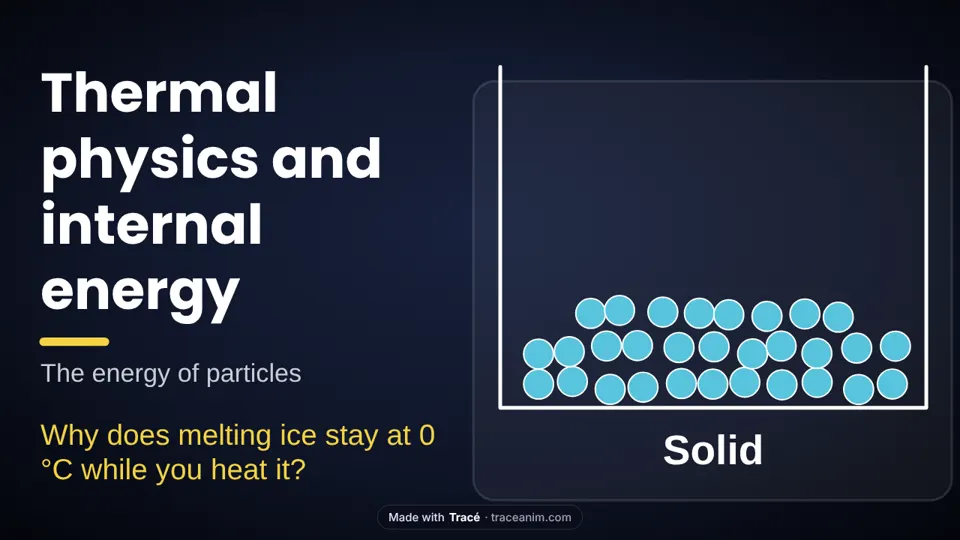
What happens to the particles when ice melts?

2 Temperature stops rising while it melts or boils

Heating ice from −20 °C

Live graph: y = {x < 1: 20·x - 20, x < 3: 0, x < 5: 50·(x - 3), x < 8: 100, 100 + 20·(x - 8)}

Flat at 0 °C: melting

Flat at 100 °C: boiling

3 Each change of state has a name

Changes are physical: they can be reversed

4 Energy to melt ice

How much energy melts 0.5 kg of ice at 0 °C? The specific latent heat of fusion of ice is 334 000 J/kg.

→ E = mL

E=mLE = m L
E=0.5×334 000E = 0.5 \times 334\,000
E=167 000 JE = 167\,000\ \text{J}

It takes 167 000 J, and the temperature stays at 0 °C

5 Quick check

Water vapour forms drops on a cold window. This is…

  • evaporating
  • condensing
  • melting
  • freezing
Show the answer

condensing

A gas turning into a liquid is condensing.

6 What to remember

Solid: fixed places, vibrating

Liquid: close, sliding past

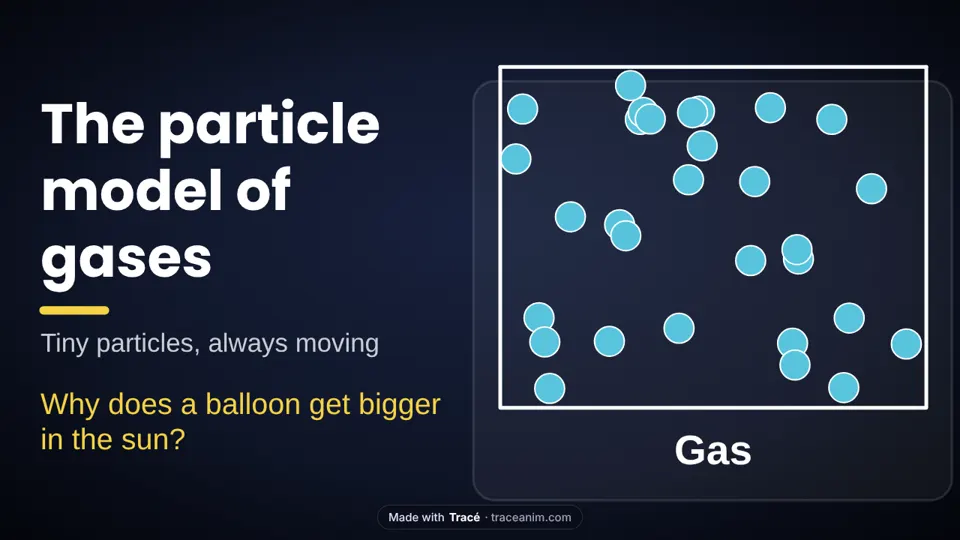
Gas: far apart, fast

Melting and boiling: temperature stays flat

Challenge: Why does sweating cool you down?

Every slide is built click by click: text, formulas and pictures come in one step at a time, so the class follows the reasoning instead of reading ahead. Graphs with sliders can be dragged live while you present.

Make your own version with AIChange the level, the numbers or the language: type the topic and get a new deck that moves in about 30 seconds. Free, no account needed.

Questions teachers ask

Why does temperature stay the same while ice melts?

The energy goes into breaking the bonds between particles instead of making them move faster, so the temperature stays at 0 °C until all the ice has melted.

Are these slides really free?

Yes. Watch them on this page or present them full screen with no account. Making your own copy to edit is free too.

Can I change the slides before my lesson?

Yes. Press "Make my own copy" and the deck becomes one of your projects in the Tracé editor, where you can change the text, the numbers, the colours or the order of the clicks.

Do they work on a classroom projector or an interactive whiteboard?

Yes. They run in the browser on any laptop, so anything that shows your screen works. Press the right arrow or click to go to the next step.