What the lesson covers
In the short run a firm cannot change its factory, so average cost falls and then rises as diminishing returns set in. Students work out average costs from a table, watch short-run cost curves line up under a long-run envelope and see why firms change scale in the long run.
The slides, one by one
1 Short-run and long-run costs
Fixed factory or free choice?
Why does a crowded kitchen make each meal dearer?
2 In the short run, something is fixed
Short run
- At least one factor fixed
- Diminishing returns to labour
- Average cost U-shaped
Long run
- Every factor can change
- Choose the best plant size
- Economies, then diseconomies of scale
How long the short run lasts depends on the industry
3 The long-run curve wraps the short-run ones
Each SRAC: one size of factory
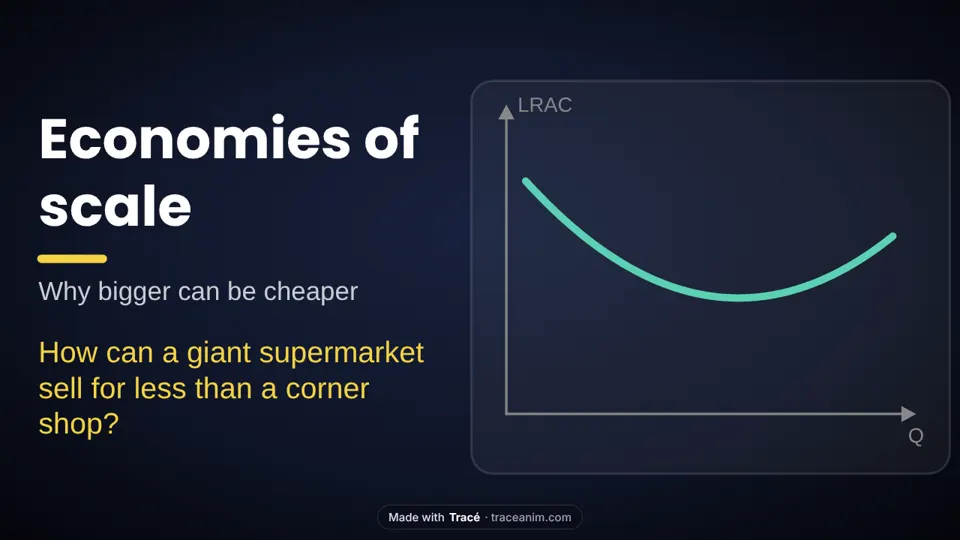
LRAC: the cheapest size for each output
4 Average cost in the short run
A bakery has fixed costs of £200 a day. Variable costs are £300 for 10 batches, £500 for 20 and £900 for 30. Find average total cost at each output.
→ ATC = (fixed + variable) ÷ output
10:\ (200 + 300) / 10 = £50
20:\ (200 + 500) / 20 = £35
30:\ (200 + 900) / 30 \approx £36.67
ATC falls from £50 to £35, then rises: diminishing returns
5 Quick check
In the long run a firm can…
- Change only its labour
- Change nothing
- Change every factor, even its factory
- Never make a loss
Show the answer
Change every factor, even its factory
The long run is the period in which every factor of production is variable.
6 What to remember
Short run: at least one fixed factor
Diminishing returns make SRAC rise
Long run: all factors variable
LRAC: lowest cost for each output
Challenge: Why might a firm stay on a short-run curve even when a bigger factory would be cheaper?
Every slide is built click by click: text, formulas and pictures come in one step at a time, so the class follows the reasoning instead of reading ahead. Graphs with sliders can be dragged live while you present.
Make your own version with AIChange the level, the numbers or the language: type the topic and get a new deck that moves in about 30 seconds. Free, no account needed.
Questions teachers ask
What is the difference between the short run and the long run in economics?
In the short run at least one factor, such as the size of the factory, is fixed. In the long run every factor can change, so the firm picks the plant size with the lowest cost: the long-run average cost curve wraps around the short-run ones.
Are these slides really free?
Yes. Watch them on this page or present them full screen with no account. Making your own copy to edit is free too.
Can I change the slides before my lesson?
Yes. Press "Make my own copy" and the deck becomes one of your projects in the Tracé editor, where you can change the text, the numbers, the colours or the order of the clicks.
Do they work on a classroom projector or an interactive whiteboard?
Yes. They run in the browser on any laptop, so anything that shows your screen works. Press the right arrow or click to go to the next step.