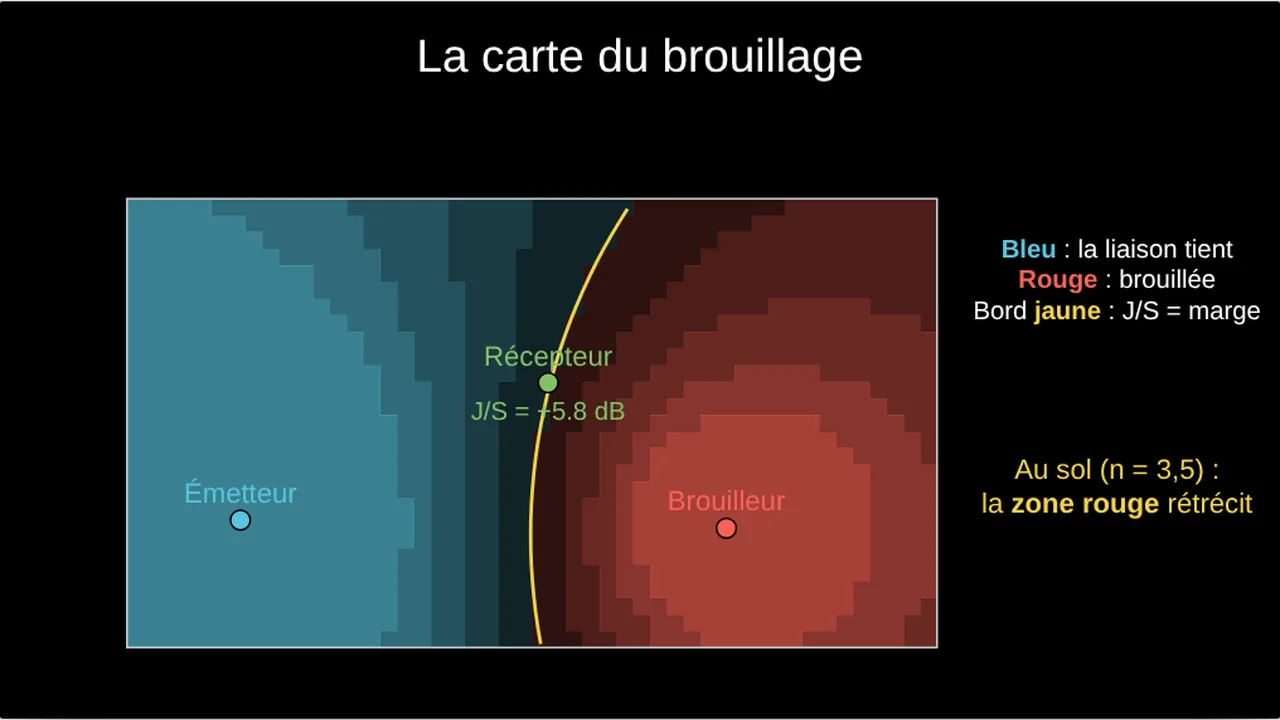
Communications jamming works by making the jammer's power at the receiver large compared with the wanted signal. Everything depends on one number, the jamming-to-signal ratio J/S at the receiver: J/S = ΔERP + 10·n·log₁₀(d_S/d_J), where ΔERP is the jammer's effective radiated power minus the transmitter's, d_S and d_J are the transmitter–receiver and jammer–receiver distances, and n is the propagation exponent (2 in free space, about 4 over the ground). A digital link usually fails around J/S = 0 dB; spread spectrum raises that threshold by its processing gain.
Why it differs from radar jamming
In radar, the echo travels out and back (1/R⁴) while a self-protection jammer travels one way (1/R²). In communications, signal and jamming both travel one way, so there is no R⁴ advantage. And the target is the receiver, not the transmitter.
A worked example
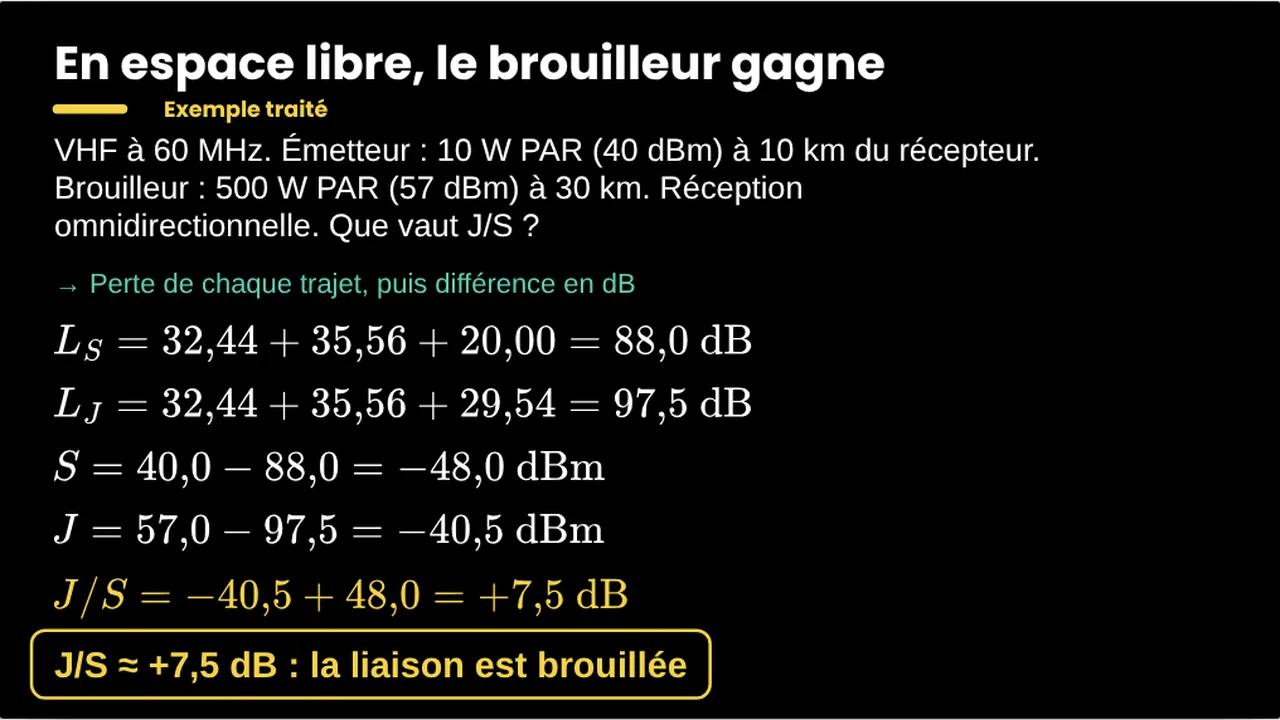
VHF link at 60 MHz. Transmitter: 10 W ERP (40 dBm) 10 km from the receiver. Jammer: 500 W ERP (57 dBm) 30 km away. Free-space loss L = 32.44 + 20 log f(MHz) + 20 log d(km): 88.0 dB for the signal, 97.5 dB for the jammer. S = −48.0 dBm, J = −40.5 dBm, so J/S = +7.5 dB: the link is jammed.
Over the ground (two-ray model, n = 4, equal antenna heights): J/S = 17 + 40 log(10/30) = 17 − 19.1 = −2.1 dB: the same link holds. The propagation model can reverse the conclusion, which is why airborne jammers are so effective.
From J/S to bit errors
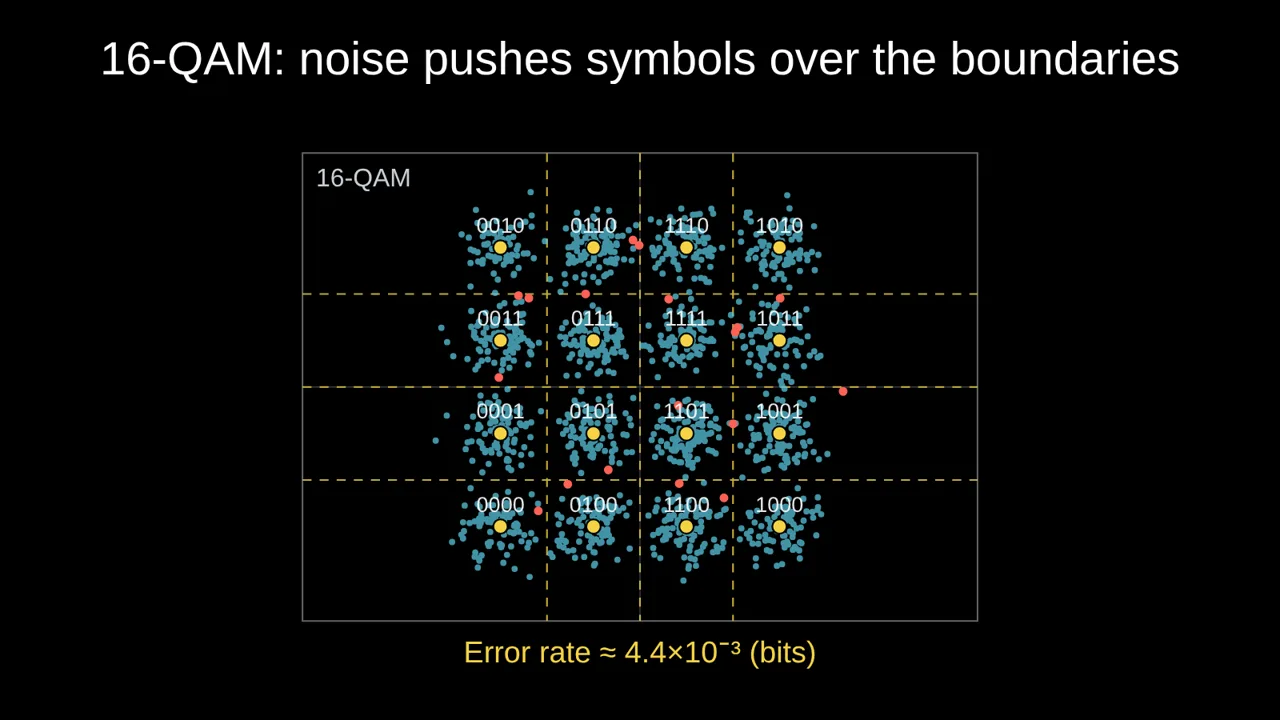
The demodulator sees energy per bit against jamming density: E_b/J_0 = (S/J)·(B/R_b). For a narrowband signal B ≈ R_b, so E_b/J_0 ≈ S/J. For BPSK, P_b = Q(√(2E_b/(N_0+J_0))): at E_b/J_0 = 0 dB, about 8% of bits are wrong.
Barrage, pulsed and follower jammers
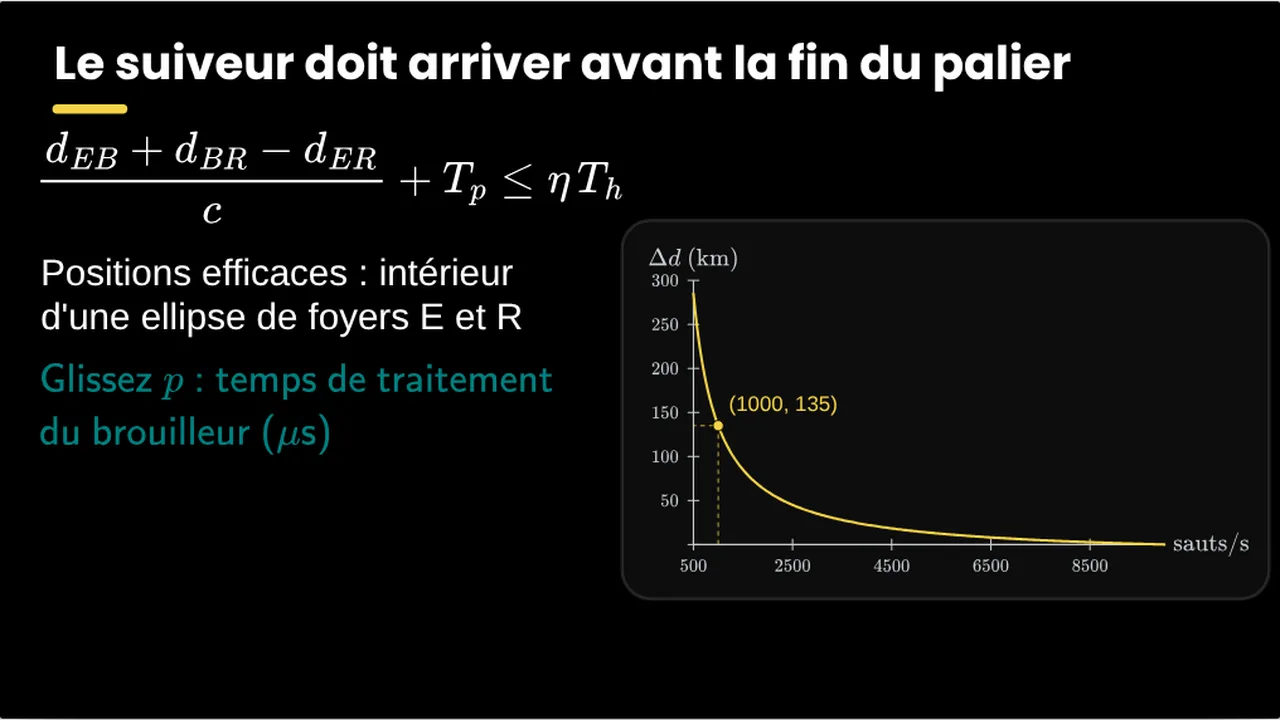
A barrage jammer covering 30–88 MHz (2,320 channels of 25 kHz) puts 10 log 2,320 = 33.7 dB less power in each channel than a spot jammer. A pulsed jammer of fixed average power that transmits a fraction ρ of the time is far worse for the link: against BPSK the worst case is ρ* = 0.709/(E_b/N_J), giving P_b ≈ 0.083/(E_b/N_J). For P_b = 10⁻⁵ the link needs 39.2 dB instead of 9.6 dB, a penalty of about 30 dB that coding with interleaving removes. A follower jammer against frequency hopping must satisfy (d_TJ + d_JR − d_TR)/c + T_p ≤ η·T_hop: its useful positions lie inside an ellipse whose foci are the transmitter and receiver, and fast hopping shrinks that ellipse.
Processing gain and the anti-jam margin
Direct-sequence spreading at 10 Mchip/s for 10 kbit/s gives G_p = 10 log(10⁷/10⁴) = 30 dB. With 10 dB of required E_b/N_0 and 2 dB of losses, the anti-jam margin is M_J = 30 − 10 − 2 = 18 dB: the jammer must exceed J/S = +18 dB at the receiver.
Burn-through range
Solving the J/S equation for the transmitter distance: d_S < d_J·10^[((J/S)_req − ΔERP)/(10n)]. With ΔERP = 17 dB, a jammer at 30 km and (J/S)_req = 0 dB, the link holds up to 4.2 km in free space and 11.3 km over the ground. With the 18 dB spread-spectrum margin, 33.7 km in free space: eight times the safe range against the same jammer.
Free slides for this lesson
All of this is in a 31-slide course with speaker notes, in French, with a live jamming map (sliders for ΔERP, n and the link margin), a constellation under jamming, frequency hopping and despreading animations. Open it in Tracé from the templates: Cours : le brouillage.
Questions
What J/S is needed to jam a communication link?
A common rule of thumb is about 0 dB for digital links and about +10 dB for analog voice, for signals that are not spread or heavily coded. Spread spectrum adds its processing gain to the required J/S.
What is the difference between ERP and EIRP?
ERP is referenced to a half-wave dipole, EIRP to an isotropic antenna: EIRP = ERP + 2.15 dB. In J/S only the difference between jammer and transmitter matters, so the reference cancels.
Why is a tone (CW) jammer weak against DSSS?
Despreading spreads the single tone over the whole spread bandwidth, so the full processing gain applies; a notch filter can also remove it.
Where do the pulsed-jamming results come from?
They are classic results in spread-spectrum theory, found in Simon, Omura, Scholtz and Levitt's Spread Spectrum Communications Handbook and in Proakis' Digital Communications.
More: Animated math slides for teachers · How to create math slides, step by step