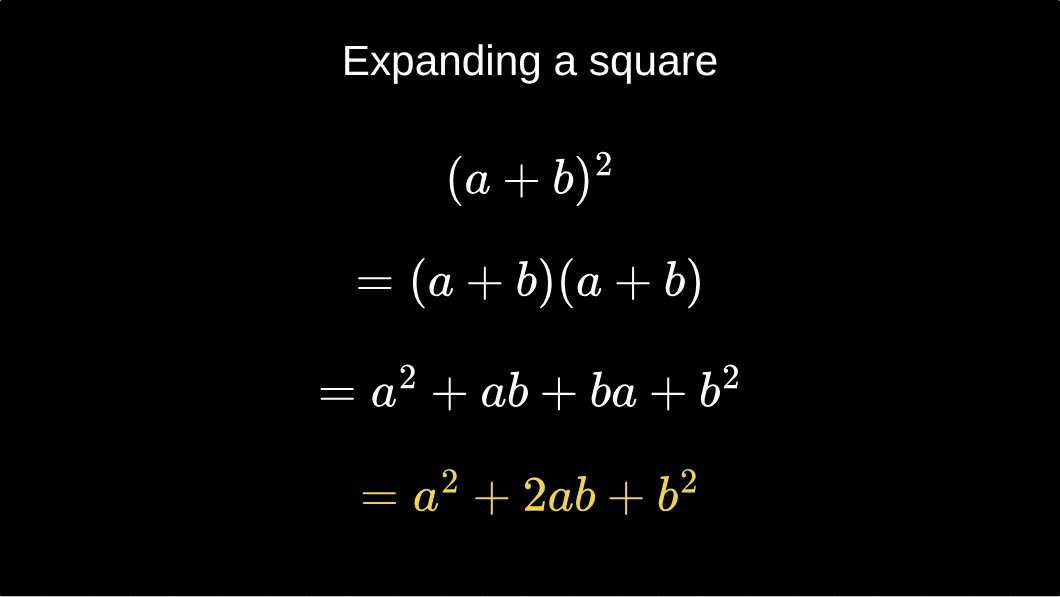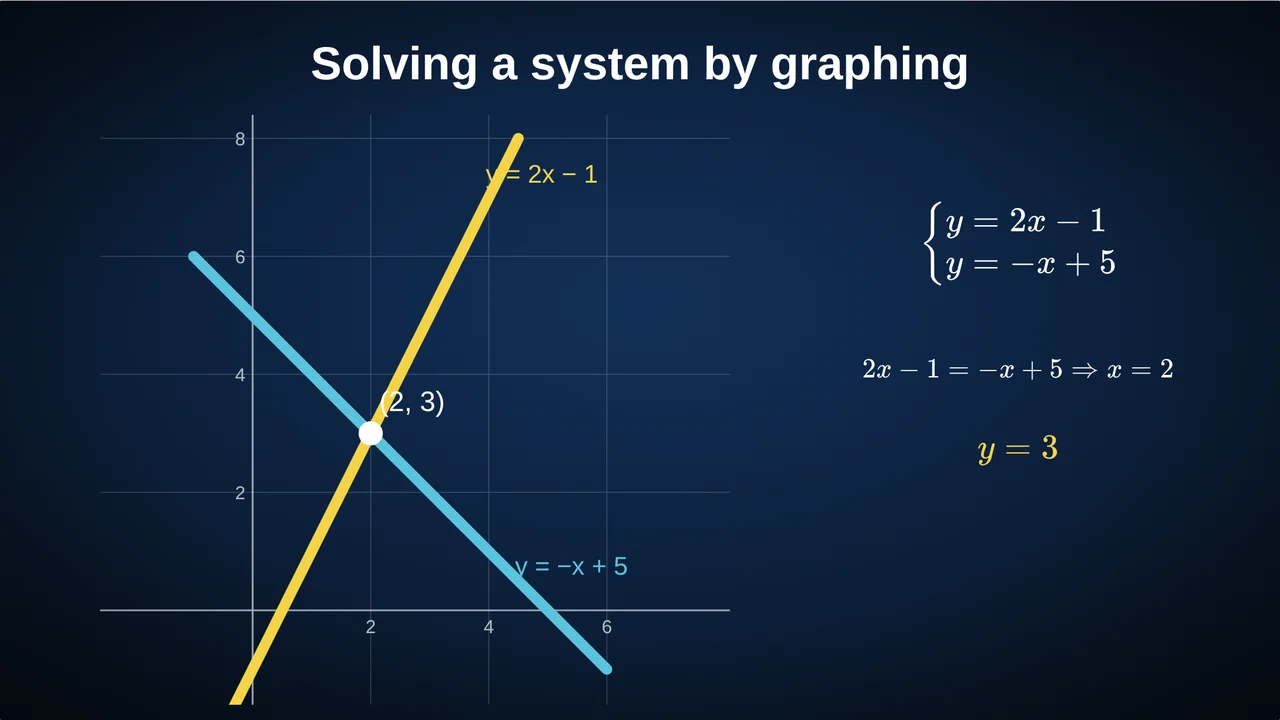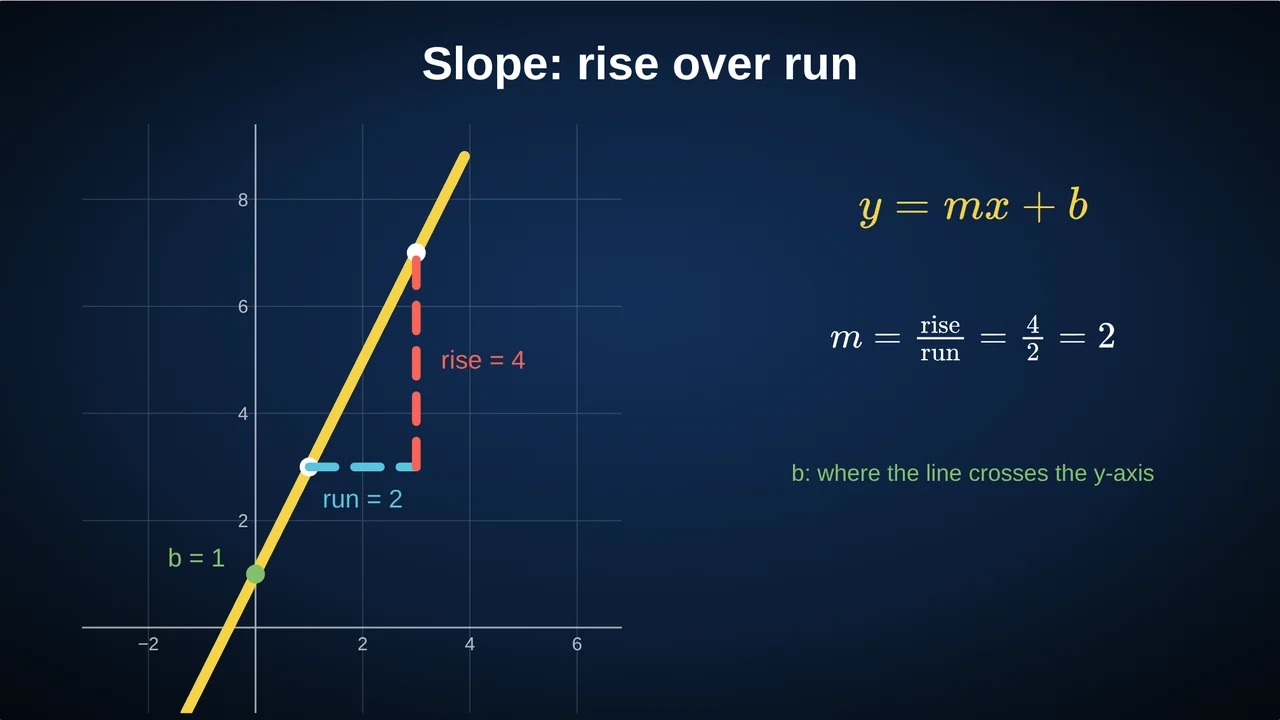
Solving linear equations means undoing what was done to x, in reverse order, while keeping both sides equal. For 3x + 5 = 20: subtract 5 from both sides, then divide both sides by 3, and x = 5. Students who see an equation as a balance make far fewer sign mistakes.
Learning objectives
- Solve one-step and two-step equations by doing the same operation to both sides.
- Solve equations with brackets and with x on both sides.
- Check a solution by substituting it back.
The opening question
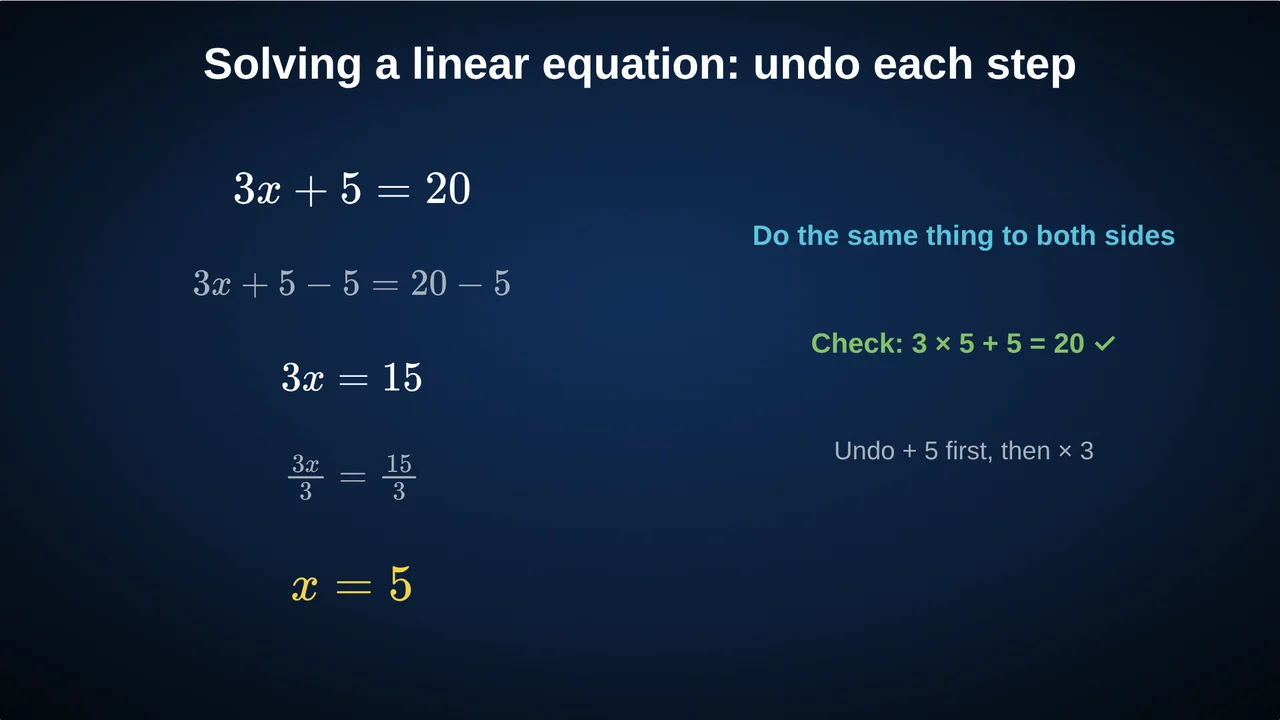
"I think of a number, multiply it by 3, add 5 and get 20. What was my number?" Most students find 5 by working backwards. That backwards path, undo + 5, then undo × 3, is exactly how the algebra works.
The lesson, click by click
- Click 0: 3x + 5 = 20, drawn as a balance: three bags of x and five counters on one side, twenty counters on the other.
- Click 1: take 5 counters off both sides: 3x = 15.
- Click 2: split both sides into three equal groups: x = 5.
- Click 3: the check, 3 × 5 + 5 = 20.
- Click 4: x on both sides, 5x − 4 = 2x + 11: subtract 2x, add 4, divide by 3, so x = 5 again.
Common mistakes to watch for
- Changing only one side. "Move the 5 over" hides the reason. Insist on "subtract 5 from both sides" until it is automatic.
- Sign errors. In 5 − 2x = 11, the term is −2x, so dividing by −2 gives x = −3.
- Undoing in the wrong order. In 3x + 5 = 20, dividing by 3 first gives x + 5/3 = 20/3: correct, but harder.
- Brackets. 2(x + 3) = 14 means 2x + 6 = 14, not 2x + 3 = 14.
Check questions
- Solve 4x − 7 = 13. (x = 5.)
- Solve 2(x + 3) = 14. (x = 4.)
- Solve 7 − 3x = x − 9. (16 = 4x, so x = 4.)
Building it in Tracé
- Type each line of the solution as an equation and make each appear on its own click, or use Solve an equation with AI and press Solve it step by step to get every step as a ready slide.
- Colour the operation applied at each step, for example "− 5" in blue on both sides.
- Add the check as a last click, in green.
Questions
When is this taught?
One- and two-step equations usually around ages 11 to 13 (grades 6 to 7 in the US Common Core), with brackets and x on both sides soon after.
Should students show every step?
Yes at first: writing the operation on both sides is what prevents sign errors. Shortcuts can come once the reasoning is solid.
Where does it lead next?
To inequalities, where dividing by a negative number flips the sign, to simultaneous equations, and to rearranging formulas such as v = u + at.
More: Animated math slides for teachers · How to create math slides, step by step