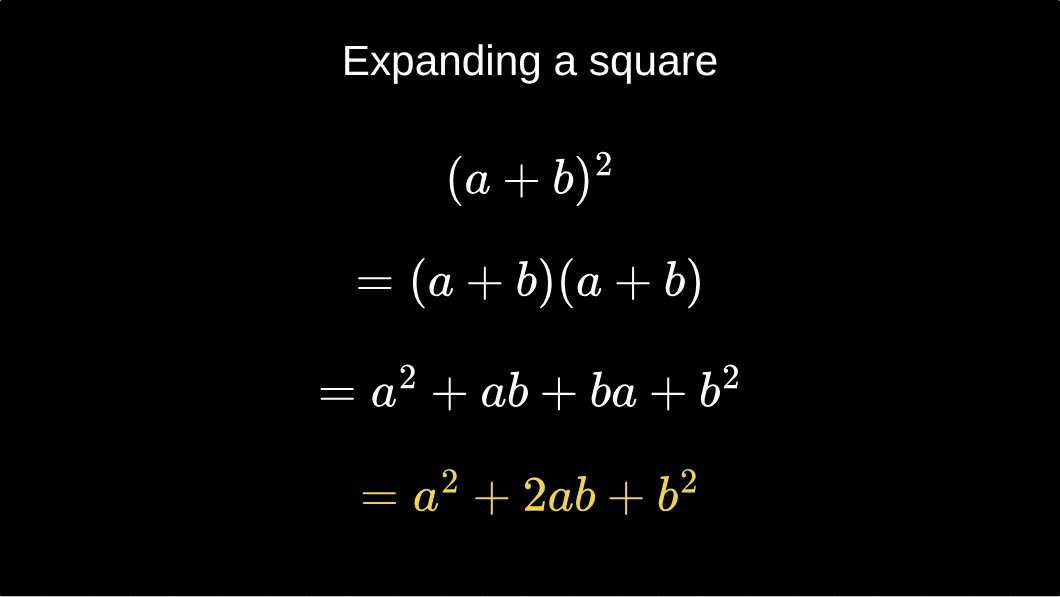
To expand brackets, multiply every term in one bracket by every term in the other. For a square: (a + b)² = a² + 2ab + b². A square of side a + b, cut into four pieces, shows where the 2ab comes from, the term students most often forget.
Learning objectives
- Expand single and double brackets.
- Explain (a + b)² = a² + 2ab + b² with an area model.
- Recognise the special products (a − b)² and (a + b)(a − b).
The opening question
"Is (3 + 4)² equal to 3² + 4²?" The left side is 49, the right side 25. The missing 24 is 2 × 3 × 4: the 2ab. Numbers first, then letters.
The lesson, click by click
- Click 0: a square of side a + b.
- Click 1: cut it into four pieces: an a × a square, a b × b square and two a × b rectangles.
- Click 2: add the areas: a² + 2ab + b².
- Click 3: the algebra: (a + b)(a + b) = a² + ab + ba + b².
- Click 4: the other special products: (a − b)² = a² − 2ab + b², and (a + b)(a − b) = a² − b².
Common mistakes to watch for
- (a + b)² = a² + b². The most common algebra mistake of all. Test it with numbers.
- Missing a product. (x + 2)(x + 5) has four products: x², 5x, 2x and 10.
- Signs. (x − 3)² = x² − 6x + 9: the last term is +9.
- Single brackets. 3(x + 4) = 3x + 12, not 3x + 4.
Check questions
- Expand (x + 3)². (x² + 6x + 9.)
- Expand (2x − 1)². (4x² − 4x + 1.)
- Work out 101² in your head. ((100 + 1)² = 10,000 + 200 + 1 = 10,201.)
Building it in Tracé
- Type each line of the expansion as an equation and reveal one per click; colour the 2ab term in yellow when it appears.
- Draw the area model with a Custom animation: two squares and two rectangles as
polygon … fillshapes, each appearing on its own click. - Present it as a "predict then reveal": ask for (3 + 4)² before showing the general rule.
Questions
Should I teach FOIL?
FOIL (first, outer, inner, last) works only for two terms times two terms. "Every term times every term", or a grid, works for any brackets.
When is this taught?
Single brackets around ages 12 to 13, double brackets and special products around 13 to 15.
Where does it lead next?
To factoring, which is expanding in reverse, and to completing the square for quadratics.
More: Animated math slides for teachers · How to create math slides, step by step