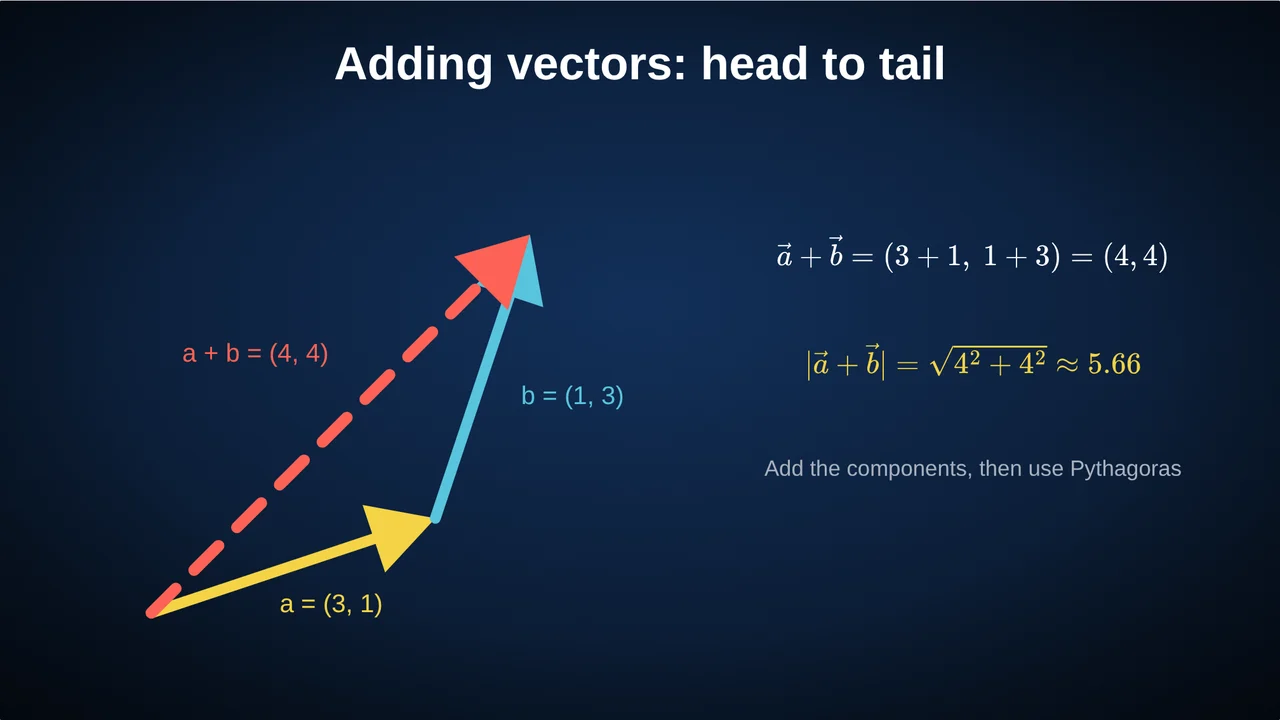
To add two vectors, draw the second one starting where the first one ends: head to tail. The sum, or resultant, goes from the start of the first to the end of the second. In components it is even simpler: add the x parts and the y parts. (3, 1) + (1, 3) = (4, 4).
Learning objectives
- Add vectors graphically, head to tail.
- Add vectors by components and find the magnitude with Pythagoras.
- Use vector addition for displacements and velocities.
The opening question
"You walk 3 km east, then 4 km north. How far are you from where you started?" Students say 7 km; the answer is 5 km. Distances walked add; displacements add as vectors.
The lesson, click by click
- Click 0: vector a = (3, 1) from the origin.
- Click 1: vector b = (1, 3) moves so that its tail sits on the head of a.
- Click 2: the resultant a + b, from the origin to (4, 4).
- Click 3: components: (3 + 1, 1 + 3) = (4, 4), and magnitude √(4² + 4²) ≈ 5.66.
- Click 4, a river: a boat heads across at 4 m/s while the current pushes it at 3 m/s: it moves at 5 m/s, about 37° downstream.
Common mistakes to watch for
- Adding magnitudes. |a| + |b| ≈ 3.16 + 3.16 = 6.32, but |a + b| ≈ 5.66. They are equal only for vectors in the same direction.
- Tail to tail. Drawing both from the same point and joining their heads gives the difference, not the sum.
- Mixing components. Add x with x and y with y, never x with y.
Check questions
- (2, −1) + (−5, 3)? ((−3, 2).)
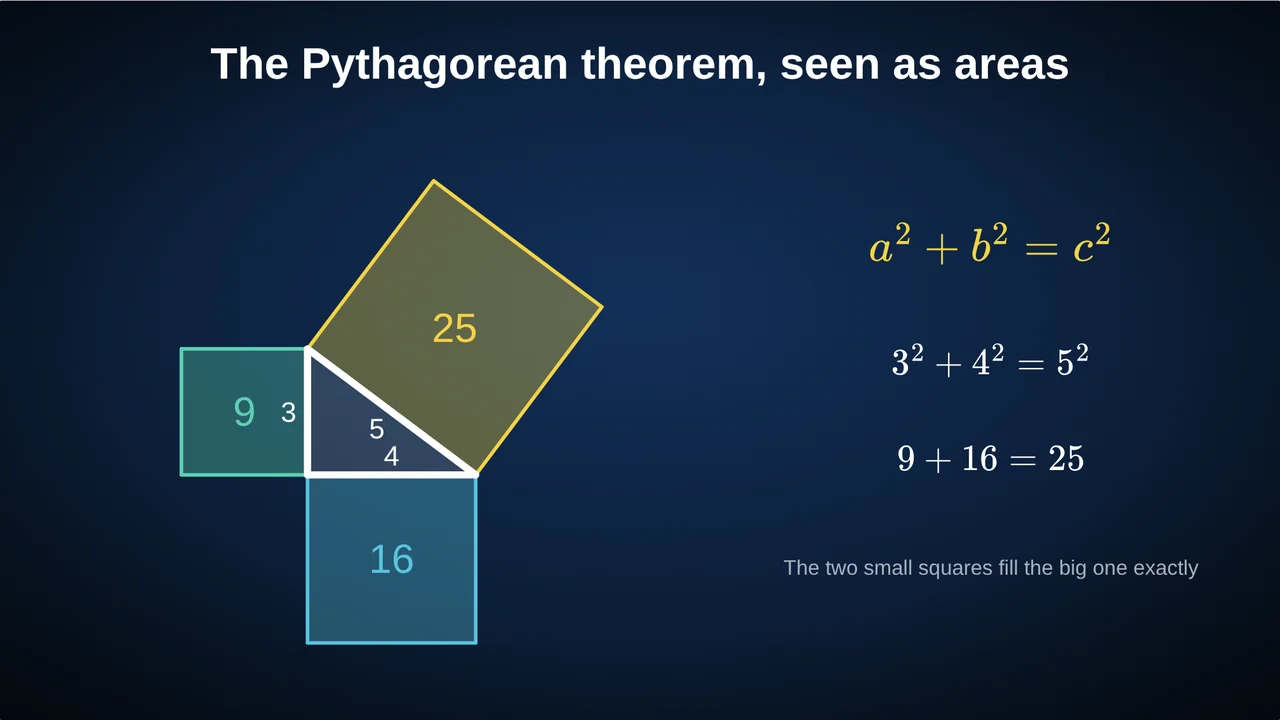
- Magnitude of (6, 8)? (10.)
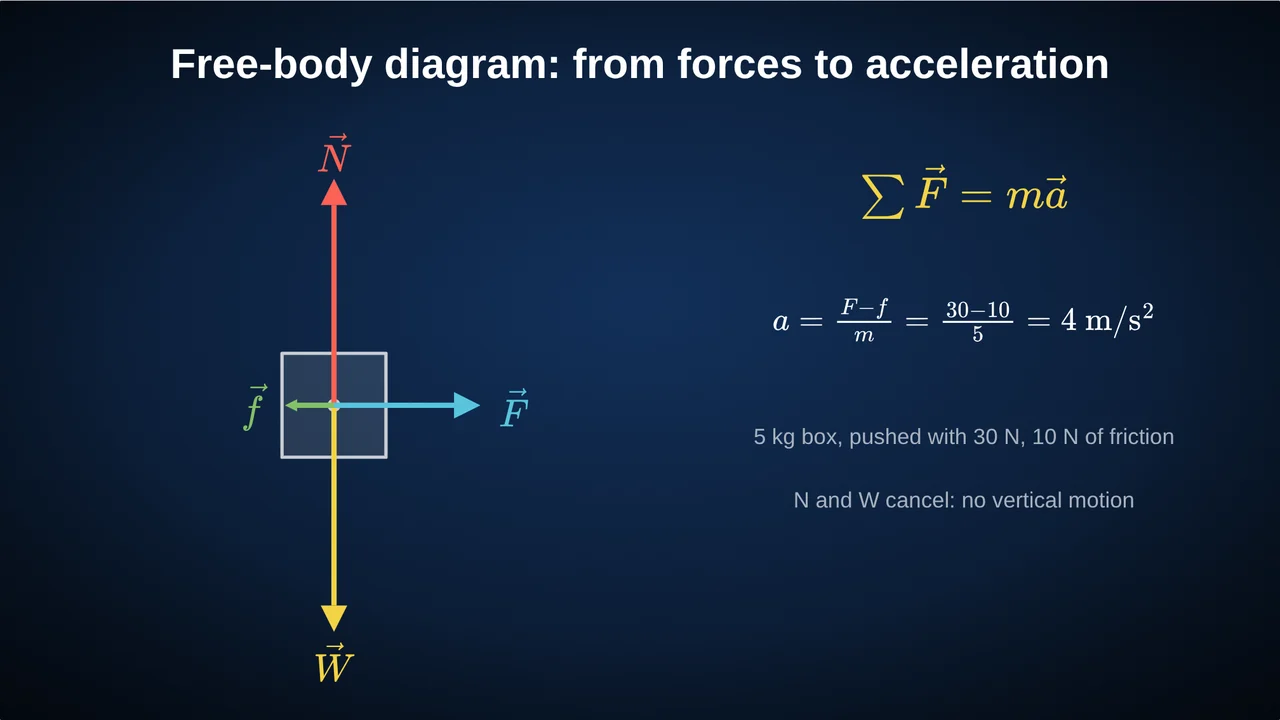
- Two forces of 3 N east and 4 N north act on a box. The resultant? (5 N, about 53° north of east.)
Building it in Tracé
- Add a Vector with x component 3 and y component 1, and a second with 1 and 3.
- On click 1, move the second vector so its tail is at (3, 1): it slides into place.
- Add the resultant on click 2, in a different colour, and the component calculation on click 3.
- For forces on an object, the Free-body diagram object draws several arrows from one box.
Questions
What is the parallelogram rule?
Draw both vectors from the same point and complete the parallelogram; its diagonal is the sum. It gives the same result as head to tail.
How do I subtract vectors?
Add the opposite: a − b = a + (−b), where −b has the same length and the opposite direction.
When is this taught?
In maths and physics from about age 14 to 16, and again for forces and velocities in mechanics.
More: Physics animations for the classroom · How to create math slides, step by step