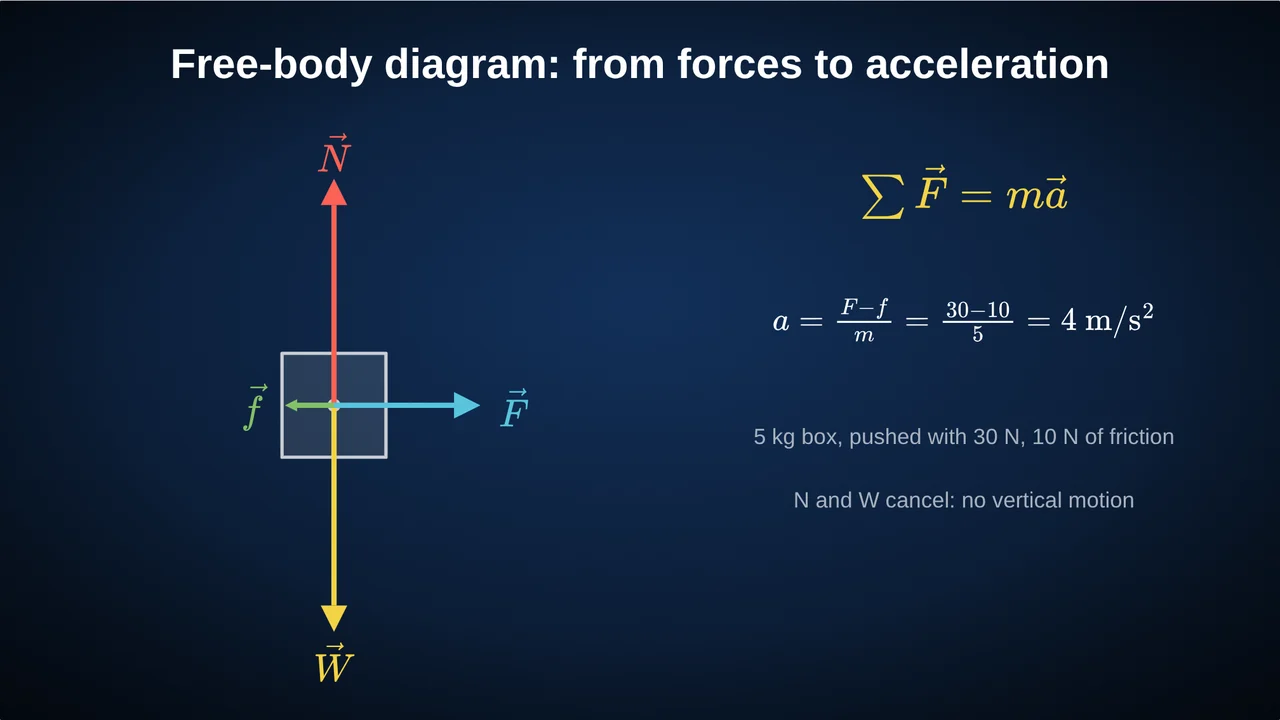
A free-body diagram shows one object and every force acting on it, as arrows. Newton's second law, ΣF = ma, then turns the diagram into an acceleration: add the forces in each direction and divide by the mass. Most mistakes in mechanics are diagram mistakes, so it pays to build the diagram slowly, one force per click.
Learning objectives
- Draw a free-body diagram with only the forces acting on the object, each labelled.
- Find the net force in each direction.
- Use ΣF = ma to find an acceleration, or a missing force.
The opening question
A box slides across the floor at constant speed while you push it. Is your push bigger than friction, smaller, or equal? Many students say bigger, "or it wouldn't move". The answer, equal, is the whole point of Newton's laws: force changes motion; it is not needed to keep it.
The lesson, click by click
- Click 0: the box alone, as a simple square: the object we study, cut out from everything around it.
- Click 1: its weight, W = mg = 5 × 9.8 = 49 N, straight down.
- Click 2: the normal force from the floor, 49 N up. Vertically the forces cancel, so there is no vertical acceleration.
- Click 3: the push, F = 30 N, and friction, f = 10 N, opposite to the motion.
- Click 4: horizontally, ΣF = 30 − 10 = 20 N, so a = 20 / 5 = 4 m/s².
Then change one number and ask for a prediction: what if friction were 30 N? (Zero acceleration: constant speed, back to the opening question.)
Common mistakes to watch for
- Drawing ma as a force. ma is the result of the forces, not one of them.
- A "force of motion". A moving object does not carry a force in its direction of travel.
- Forces the object exerts on others. Only forces acting on the box belong in its diagram; their reaction pairs act on other objects.
- "The normal force always equals the weight." Not on a slope (it is mg cos θ there), and not when someone also pushes down or pulls up.
Check questions
- A 2 kg trolley is pulled with 10 N and there is no friction. What is its acceleration? (5 m/s².)
- A 10 kg crate moves at constant speed while pushed with 40 N. What is the friction force? (40 N: the acceleration is zero, so the forces balance.)
- A book rests on a table. Name the two forces on its free-body diagram. (Its weight and the normal force from the table.)
Building it in Tracé
- Add a Free-body diagram and list the forces, one per line, as label and direction:
\vec{W}: 0, -2.4,\vec{N}: 0, 2.4,\vec{F}: 1.55, 0,\vec{f}: -0.52, 0. - Make each force appear on its own click by keeping one diagram per step, or start with only the weight and add a line on each click.
- Add the calculation as a step-by-step equation on the last clicks.
- For slopes, the Inclined plane object can show the weight, the normal force, friction and the weight's components, each with its own checkbox.
Questions
Should arrow lengths match the force sizes?
Ideally yes, at least roughly: equal forces as equal arrows, a bigger force as a longer arrow. It lets students see whether the net force is zero before calculating.
What value of g should students use?
9.8 m/s² (or 9.81). Some courses use 10 m/s² to keep the arithmetic simple; say which one at the start.
Where does this lead next?
To inclined planes, connected objects over pulleys, circular motion (where the net force points to the centre), and Newton's third law.
More: Physics animations for the classroom · How to create math slides, step by step