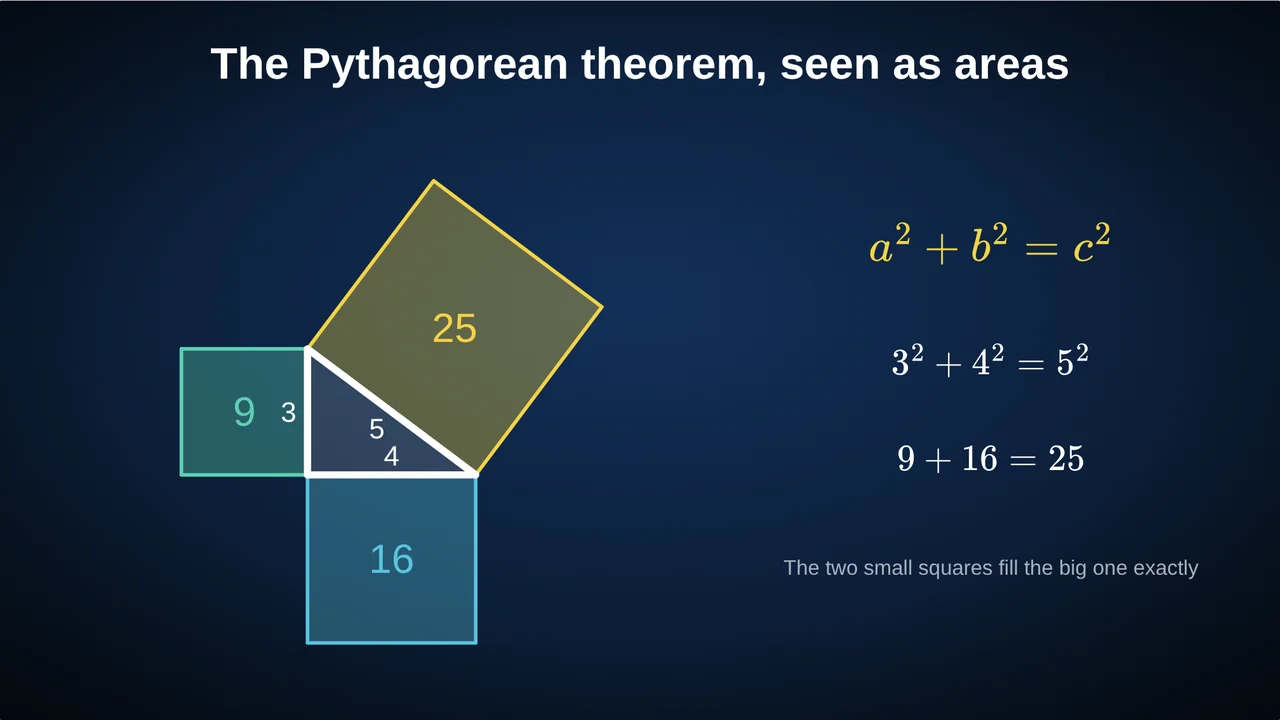
In a right triangle, the square on the longest side has the same area as the two other squares together: a² + b² = c². Students remember it best when they see it as areas first and as a formula second. Here is a lesson built around that picture, one click at a time.
Learning objectives
- State the theorem and say which side is the hypotenuse.
- Explain why it is true with an area argument.
- Find a missing side, and tell whether a triangle is right-angled from its three sides.
The opening question
Show a 3-4-5 triangle with a square drawn on each side, and ask: is there a link between the three squares? Let students count unit squares, or measure, before saying anything. Most notice that 9 + 16 = 25 within a minute.
The lesson, click by click
- Click 0: the right triangle, sides 3 and 4, right angle marked.
- Click 1: a square appears on each side, with its area: 9, 16, 25.
- Click 2: the equation 9 + 16 = 25, then a² + b² = c².
- Click 3, the proof: four copies of the triangle inside a square of side a + b. The space left is a tilted square of area c².
- Click 4: rearrange the same four triangles. Now the space left is two squares, of areas a² and b². The big square and the triangles have not changed, so a² + b² = c².
The algebra version of click 4: (a + b)² = c² + 4 × ½ab, so a² + 2ab + b² = c² + 2ab, and the 2ab cancels.
Common mistakes to watch for
- Using it on any triangle. It only works with a right angle. Show a 6-8-11 triangle: 36 + 64 = 100, not 121.
- Picking the wrong c. c is the hypotenuse, the side opposite the right angle, not "the last number in the question".
- Adding sides instead of squares. 3 + 4 is not 5: the areas add, not the lengths.
- Forgetting the square root. c² = 25 gives c = 5, not 25.
Check questions
- A 13 m ladder stands with its foot 5 m from a wall. How high does it reach? (√(169 − 25) = 12 m.)
- Is a triangle with sides 8, 15 and 17 right-angled? (64 + 225 = 289 = 17², yes.)
- Is a triangle with sides 6, 8 and 11 right-angled? (36 + 64 = 100, not 121: no, the angle is obtuse.)
Building it in Tracé
- Add a Triangle, set its corners for a 3-4-5 triangle, and tick Mark the angles.
- Draw the three squares in a Custom animation, for example
polygon (0, 0), (0, 3), (-3, 3), (-3, 0) color teal fill, and make them appear on click 1. - Add the equations as text or LaTeX on clicks 2 and 3.
- For the rearrangement proof, give each triangle a new position on click 4: it slides there smoothly when you present.
Questions
What age is this lesson for?
It is usually taught around ages 12 to 14 (grade 8 in the US Common Core). The area picture works from the first lesson; the algebra proof suits students who can expand (a + b)².
Which Pythagorean triples are worth knowing?
3-4-5, 5-12-13, 8-15-17 and 7-24-25, plus their multiples such as 6-8-10. They make clean exercises with whole-number answers.
Where does it lead next?
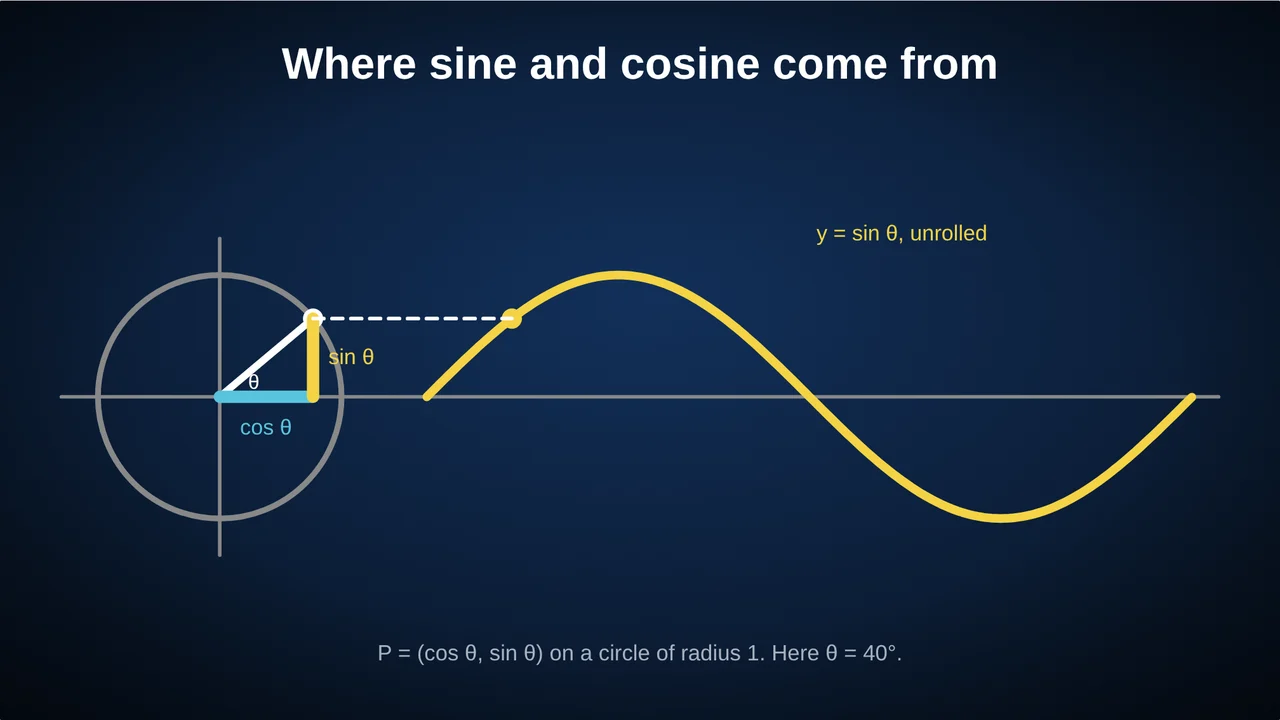
To distance between two points, √((x₂ − x₁)² + (y₂ − y₁)²), and to the unit circle, where it becomes sin²θ + cos²θ = 1.
More: Animated math slides for teachers · How to create math slides, step by step