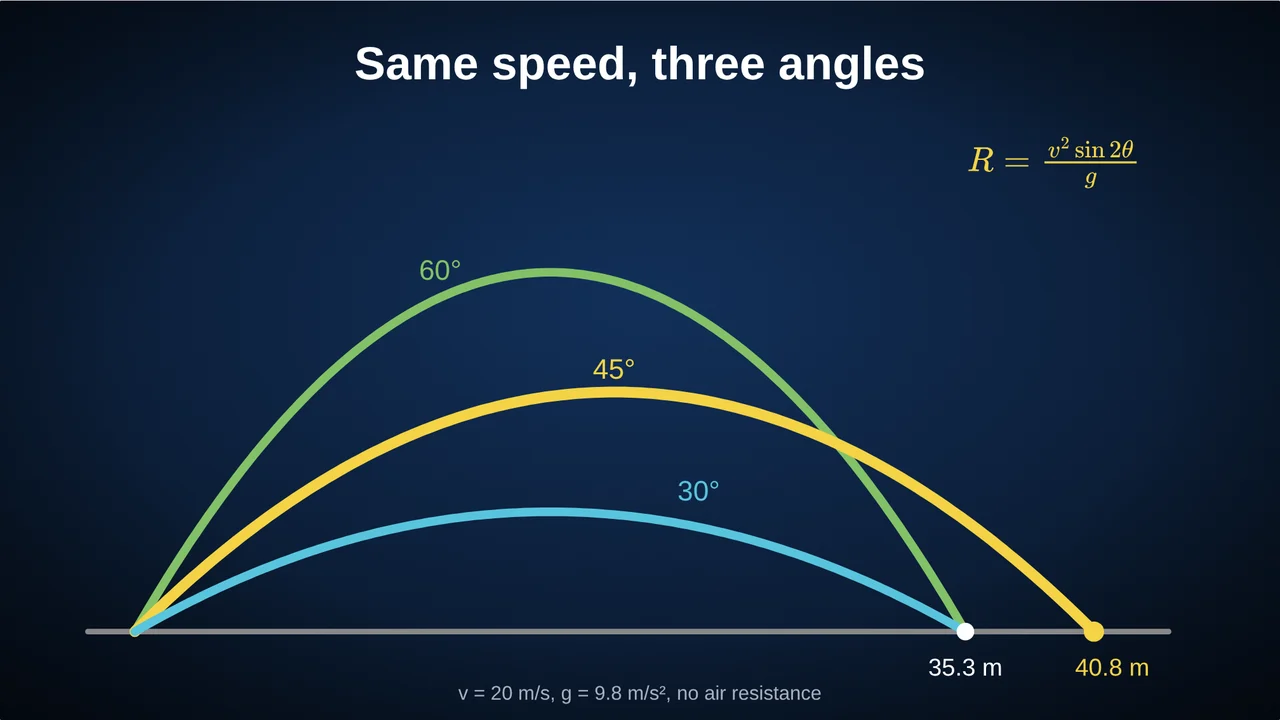
With no air resistance and a launch from ground level, a projectile goes furthest when it leaves at 45°. The reason fits in one line: the range is proportional to sin 2θ, and a sine is largest at 90°. Real throws use less than 45° because they start above the ground and push through air.
The range formula in three steps
Launch at speed v and angle θ above the horizontal, with gravity g and no air resistance.
- The vertical speed is v sin θ, so the flight lasts T = 2v sin θ / g: the time to stop rising, twice.
- The horizontal speed v cos θ never changes, so the range is R = v cos θ · T = 2v² sin θ cos θ / g.
- Since 2 sin θ cos θ = sin 2θ: R = v² sin 2θ / g.
sin 2θ reaches its maximum of 1 when 2θ = 90°, so θ = 45°. At 20 m/s that gives 20² / 9.8 ≈ 40.8 m.
Why 30° and 60° land together
Any two angles that add up to 90° give the same range, because sin 2θ = sin(180° − 2θ). At 20 m/s, 30° and 60° both land at 35.3 m. The steep throw goes higher and stays in the air longer, but moves forward more slowly, and the two effects cancel exactly.
This makes a good question for a class: predict which lands further, 30° or 60°. Most students pick one; almost nobody guesses they tie.
Launching from above the ground
A shot-putter releases the shot about 2 m above the ground. The ball then has extra time to fall, which favours a flatter throw. Without air, the best angle from a height h satisfies tan θ = v / √(v² + 2gh).
For a release at 14 m/s from 2.1 m: tan θ = 14 / √(196 + 41.2) ≈ 0.91, so θ ≈ 42°, already below 45°. Measured release angles of top shot-putters are usually lower still, in the high 30s, partly because the body can push harder at a flatter angle.
Air resistance changes everything
Drag slows a ball the whole time it is in the air, so long, high flights lose the most. The best angle drops below 45°, by an amount that depends on the ball's speed, size and spin. A long jumper takes off at about 20°, because jumping steeply would cost too much running speed. A golf drive leaves the tee at a much lower angle still, because backspin gives the ball lift.
So 45° is the right answer to a precise question: same launch speed, level ground, no air. Changing any of those changes the answer, which is a good lesson in itself.
Building the slide in Tracé
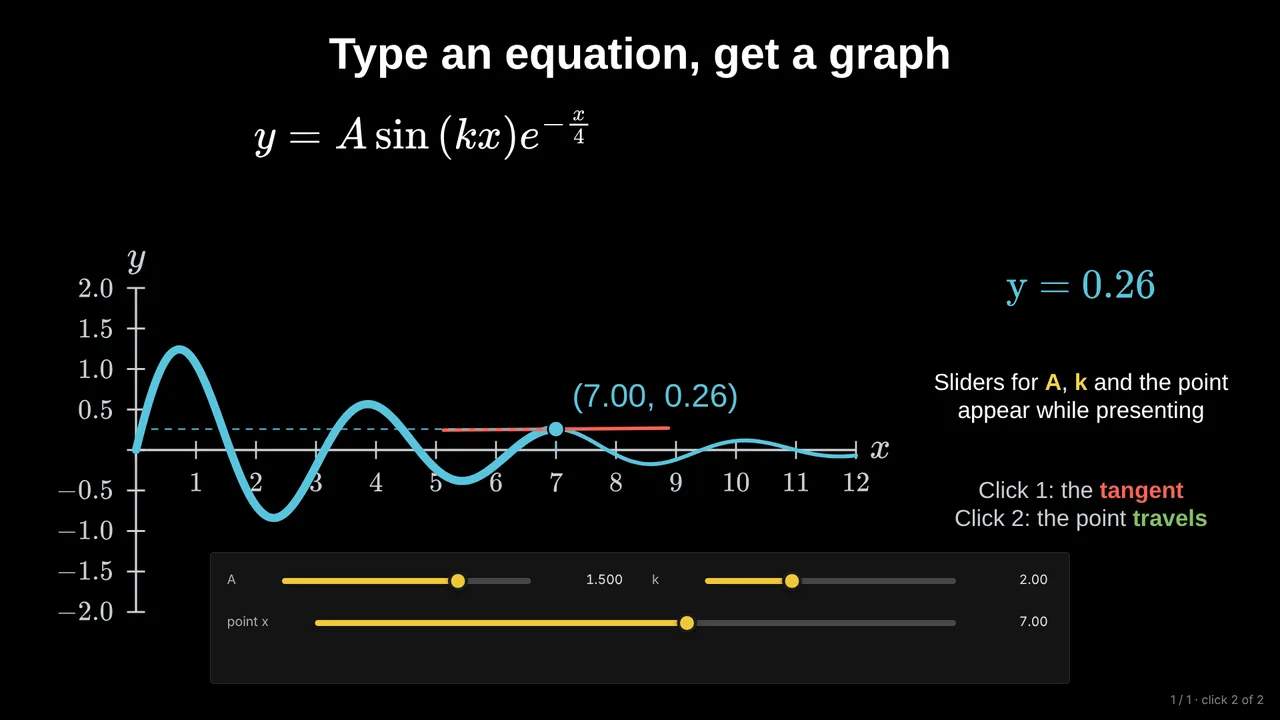
- Add an equation and type the trajectory:
y = x tan(θ) - 9.8 x^2 / (2 v^2 cos(θ)^2). - Press Plot this equation as a graph, then tick Live slider for θ and for v.
- Present it: drag θ from 30° to 60° and let the class watch the range rise, peak at 45° and fall again.
For the "30° or 60°?" question, put both trajectories on one graph and reveal the landing points on a click, after the class has voted.
Questions
Does a heavier ball go further at 45°?
Not without air: mass cancels out of the range formula, so any ball thrown at the same speed and angle lands in the same place. With air, a heavier ball of the same size is slowed less, so it does go a little further.
Is 45° the best angle for the highest throw?
No. The highest throw is straight up, at 90°. 45° maximises the horizontal distance, not the height.
What if the target is higher or lower than the launch point?
The best angle changes: a lower target favours a flatter throw (below 45°), a higher one a steeper throw. Setting the trajectory equal to the target height and solving for θ gives the answer.
More: Physics animations for the classroom · How to create math slides, step by step