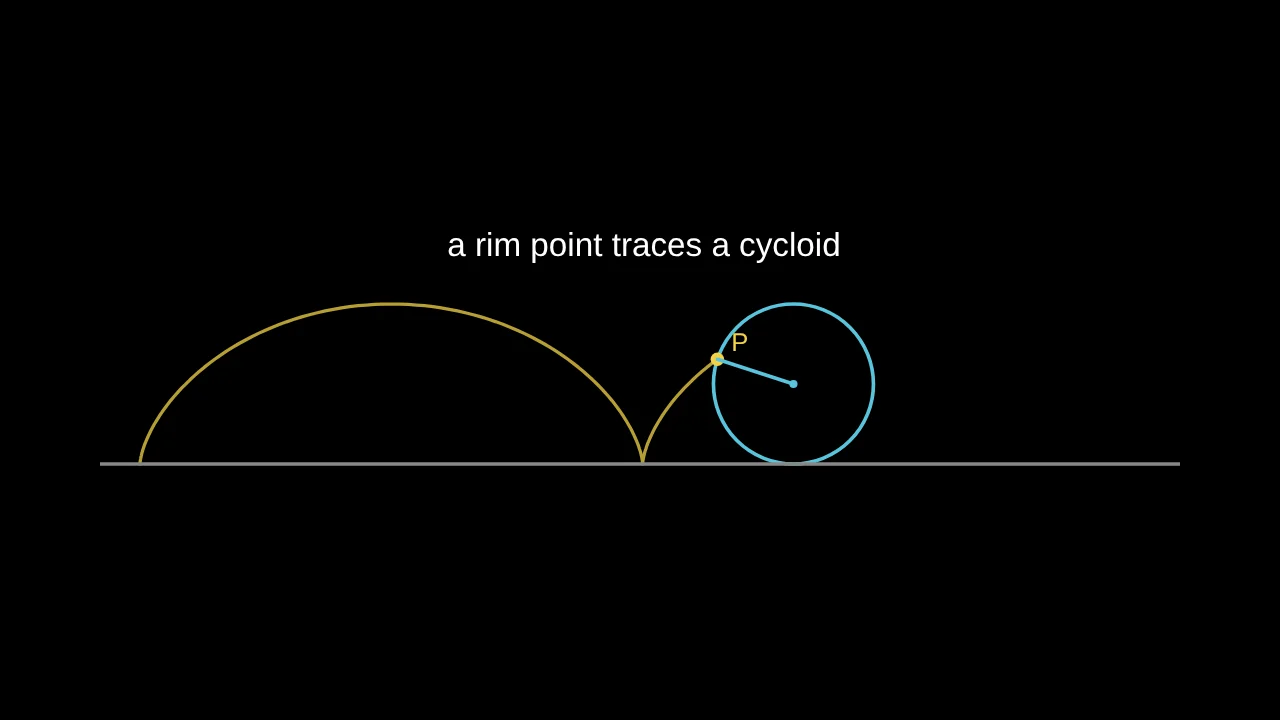
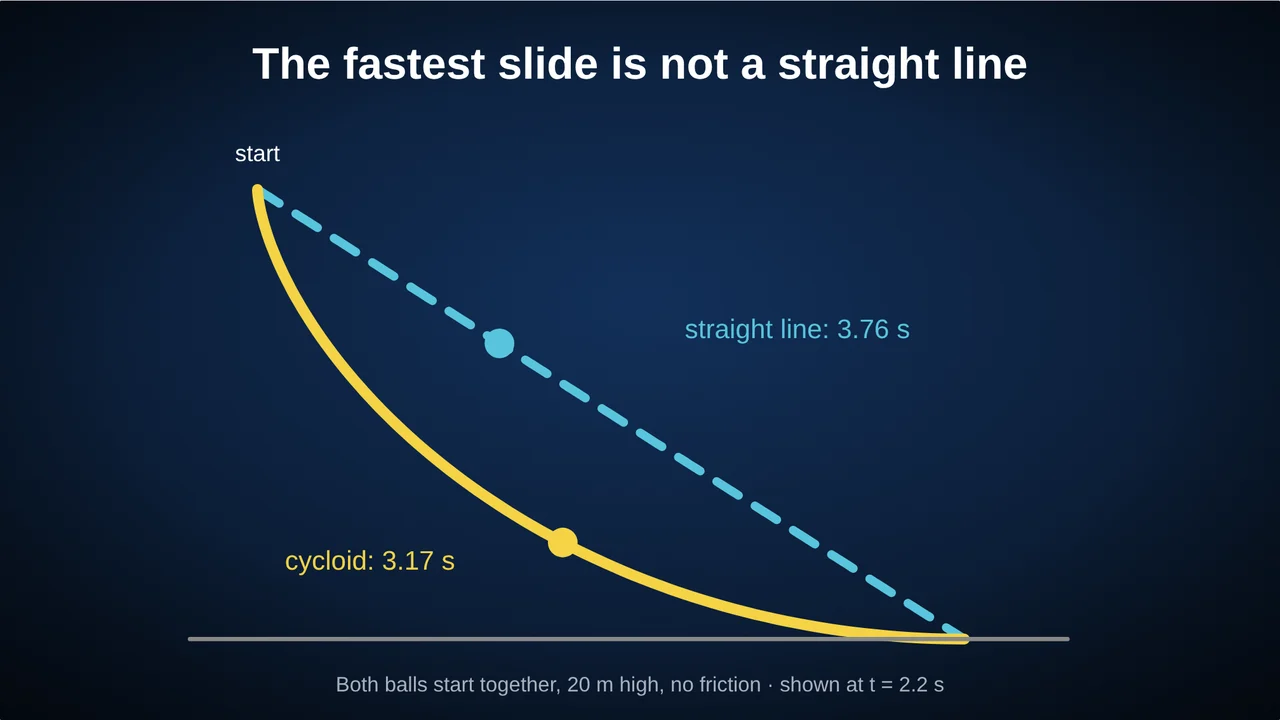
The quickest way for a ball to roll between two points is not the straight line between them. It is a curve called a cycloid, which drops steeply at first so the ball gains speed early. For a 20 m drop, the cycloid takes 3.17 s and the straight ramp 3.76 s, even though the curve is longer.
The race in numbers
Take two points 20 m apart vertically and 31.4 m apart horizontally, no friction, g = 9.81 m/s².
- Straight ramp: the ramp is 37.2 m long, and the ball accelerates at g × 20 / 37.2 ≈ 5.27 m/s² along it. From 37.2 = ½ × 5.27 × t², the ball takes 3.76 s.
- Cycloid: the curve traced by a point on a rolling wheel of radius r = 10 m. Sliding from the top of the arch to its lowest point takes π√(r/g), which is 3.17 s.
The cycloid is about 16% faster. The straight line is the shortest path, but distance is not what matters here: speed is, and speed comes from height already lost.
Why a curve wins
A ball's speed depends only on how far it has dropped: v = √(2gh). A path that dives steeply at the start turns height into speed at once, and the ball then covers most of the distance fast. The straight ramp spends its whole length accelerating gently.
Diving too steeply is not the answer either: a path that drops straight down and then runs flat wastes time on the long flat part. The cycloid is the exact balance between the two, and finding it needs the calculus of variations.
A challenge from 1696
Johann Bernoulli posed the problem in 1696 as a challenge to the mathematicians of Europe. Solutions came from Jakob Bernoulli, Leibniz, L'Hôpital and Newton. The name comes from Greek: brachistos, shortest, and chronos, time.
The cycloid has a second surprise. A ball released from any point on the curve reaches the bottom in the same time. That property, the tautochrone, was found by Christiaan Huygens, who tried to use it to build more accurate pendulum clocks.
Animating the race in Tracé
The race is a few lines in a custom animation, where the position of each ball is written as a function of time t:
- Draw the cycloid:
path (10 (s - sin(s)), -10 (1 - cos(s))) for s from 0 to pi. - Add the ball on it:
point P = (10 (0.99 t - sin(0.99 t)), -10 (1 - cos(0.99 t))) trail. The 0.99 is √(g/r). - Draw the straight ramp and its ball, which moves ½ × 5.27 × t² along the line.
- Set it to play when the slide appears, and ask the class to bet on the winner first.
Questions
Does the result hold with friction?
Not exactly. Friction changes the fastest curve a little, but it is still a curve that starts steep, and it still beats the straight line in practical setups.
What if the end point is lower than the bottom of the cycloid?
The fastest path is always an arc of some cycloid through both points. If the end point is far away horizontally, the best path even dips below it and comes back up.
Is this related to the pendulum?
Yes: a pendulum swinging on a cycloid takes exactly the same time for every swing, whatever its size. That is Huygens' tautochrone, and it is why he studied the curve.
More: Physics animations for the classroom · How to create math slides, step by step