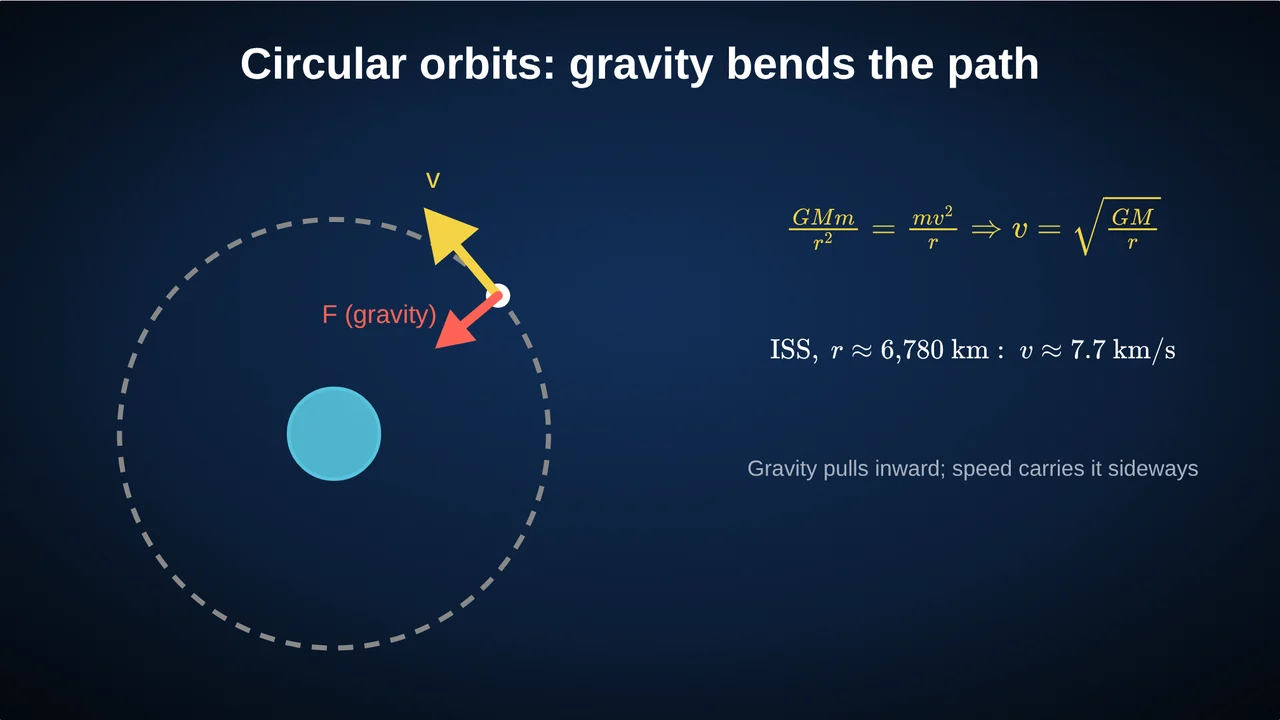
A satellite in orbit is falling all the time: gravity pulls it towards Earth, but it moves sideways so fast that the ground curves away beneath it. In a circular orbit, gravity provides exactly the centripetal force: GMm/r² = mv²/r, so v = √(GM/r). For the International Space Station that is about 7.7 km/s.
Learning objectives
- Explain an orbit as free fall combined with sideways speed.
- Derive and use v = √(GM/r) and the orbital period T = 2πr/v.
- Compare low Earth orbit and geostationary orbit.
The opening question
"Is there gravity on the International Space Station?" Most say no, because astronauts float. At 400 km up, gravity is still about 8.7 m/s², 88% of its value on the ground. The astronauts float because they and the station fall together.
The lesson, click by click
- Click 0: Newton's cannon: a cannonball fired from a mountain at increasing speeds lands further and further away.
- Click 1: at about 7.9 km/s, near the ground, it falls around the Earth instead of into it: an orbit.
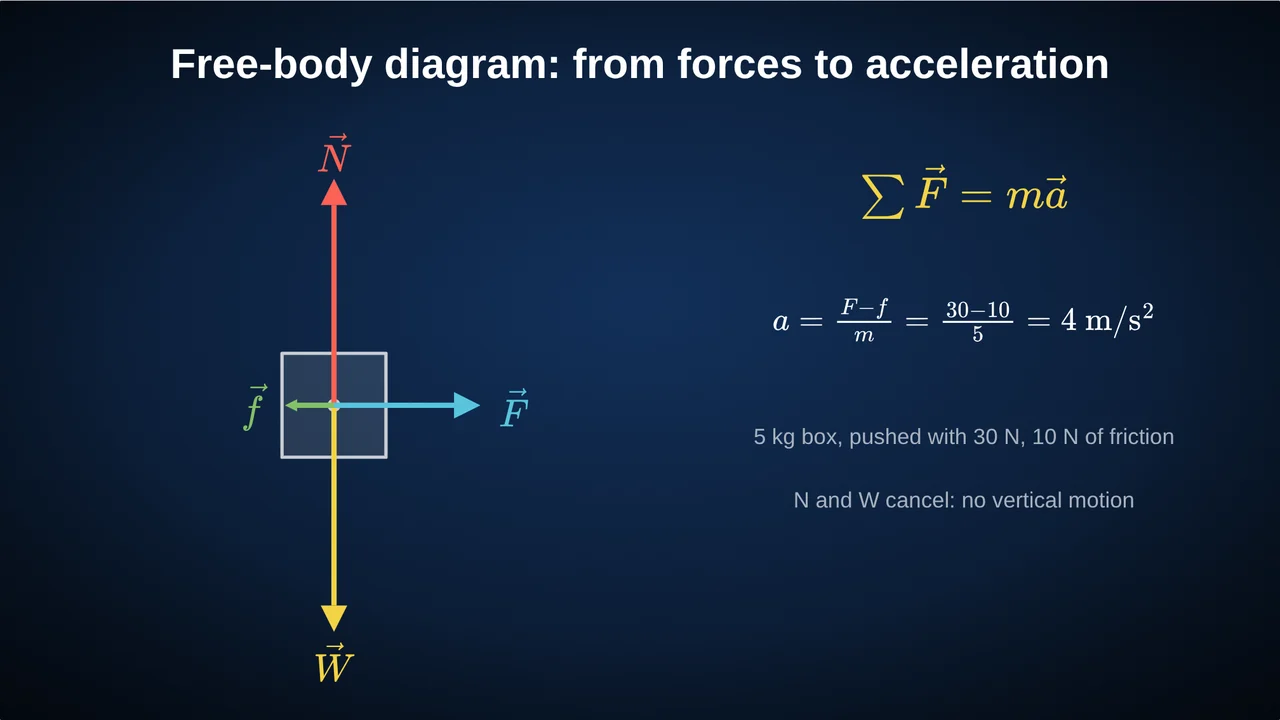
- Click 2: the free-body diagram: one force, gravity, towards the centre, perpendicular to the velocity.
- Click 3: GMm/r² = mv²/r gives v = √(GM/r). For the ISS, r ≈ 6,780 km: v ≈ 7.7 km/s and T ≈ 92 minutes.
- Click 4: further out, slower: at r ≈ 42,200 km, v ≈ 3.1 km/s and T = 24 hours. That is the geostationary orbit.
Common mistakes to watch for
- "No gravity in space." Gravity keeps the satellite in orbit; without it, the satellite would fly off in a straight line.
- A forward force is needed. In a circular orbit no force acts along the motion; the speed stays constant on its own.
- Heavier satellites go faster. The satellite's mass cancels out of v = √(GM/r).
- r is the altitude. r is measured from Earth's centre: about 6,371 km plus the altitude.
Check questions
- Why does a higher orbit have a lower speed? (Gravity is weaker further out, so less speed is needed to balance it.)
- Find the ISS period from r = 6,780 km and v = 7.67 km/s. (2π × 6,780 / 7.67 ≈ 5,550 s ≈ 92.6 min.)
- What is the net force on a satellite in a circular orbit? (Gravity alone, towards Earth's centre.)
Building it in Tracé
- Add a planet and a satellite from the drawing library, and draw the orbit as a circle.
- Write the motion in a Custom animation:
point S = (r cos(2 pi u), r sin(2 pi u)), with an arrow for the velocity and another towards the centre. - Reveal the force balance and the formula on the next clicks.
Questions
What is GM for Earth?
GM ≈ 3.986 × 10¹⁴ m³/s². Using it directly avoids multiplying G and Earth's mass separately.
Why are most orbits not perfect circles?
A satellite that is slightly too fast or slow for a circle follows an ellipse, as Kepler described for the planets.
When is this taught?
In the last years of high school physics (ages 16 to 18), with circular motion and Newton's law of gravitation.
More: Physics animations for the classroom · How to create math slides, step by step