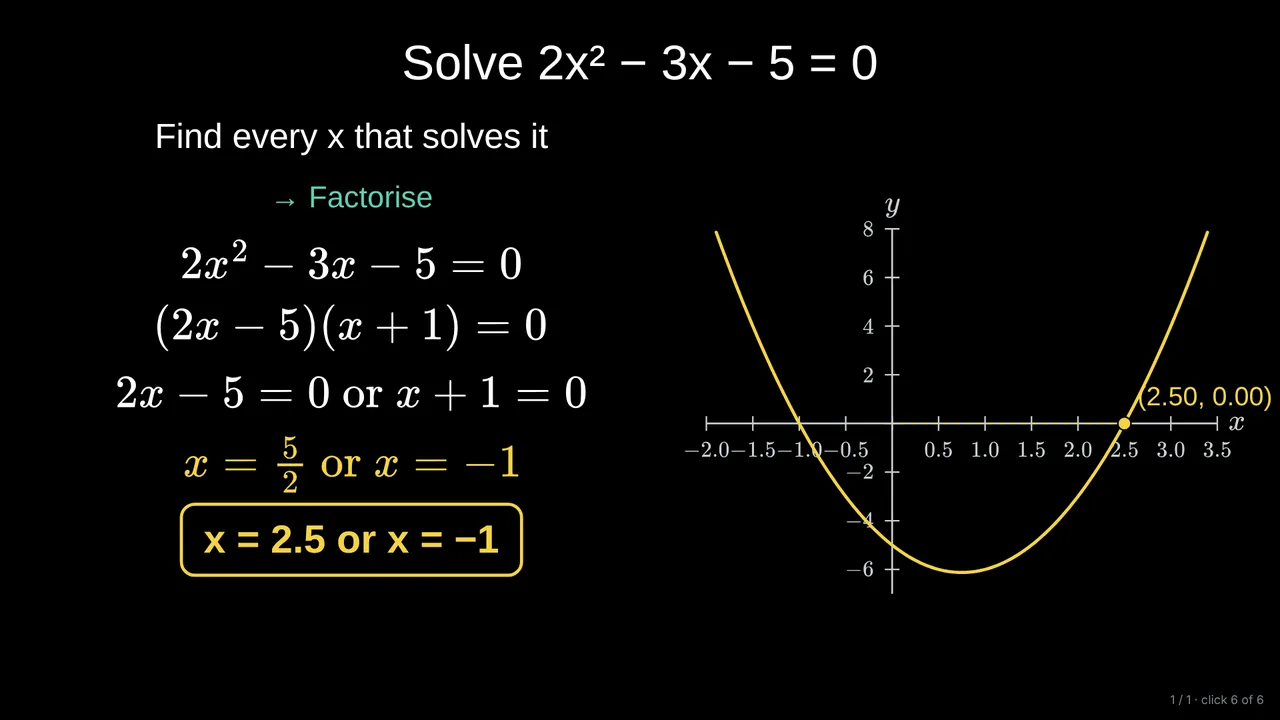
To solve a quadratic equation by factoring, write it as something = 0, factor the left side into two brackets, and use the zero-product rule: if a product is zero, one of the factors is zero. For 2x² − 3x − 5 = 0, the factors are (2x − 5)(x + 1), so x = 2.5 or x = −1.
Learning objectives
- Rearrange a quadratic equation to = 0 and factor it.
- Use the zero-product rule to find both solutions.
- Connect the solutions to where the graph crosses the x-axis.
The opening question
"Two numbers multiply to give zero. What can you say about them?" Students quickly agree that one of them must be zero. That single fact is the whole method; the rest is getting the equation into the shape where it applies.
The lesson, click by click
- Click 0: 2x² − 3x − 5 = 0 and its graph.
- Click 1, product–sum: a × c = 2 × (−5) = −10. Find two numbers that multiply to −10 and add to −3: −5 and 2.
- Click 2: split the middle term, 2x² − 5x + 2x − 5, and group: x(2x − 5) + 1(2x − 5) = (2x − 5)(x + 1).
- Click 3: 2x − 5 = 0 or x + 1 = 0, so x = 2.5 or x = −1.
- Click 4: the two points light up on the graph, where it crosses the x-axis.
Common mistakes to watch for
- Not setting it to zero. x² + x = 6 does not factor usefully as x(x + 1) = 6. Rearrange first: (x + 3)(x − 2) = 0.
- Dividing by x. From x² = 4x, dividing by x loses the solution x = 0. Factor instead: x(x − 4) = 0.
- Sign of the root. (x + 1) = 0 gives x = −1, not +1.
- Giving up when it won't factor. Some quadratics have no whole-number factors; then use the quadratic formula.
Check questions
- Solve x² − 5x + 6 = 0. (x = 2 or 3.)
- Solve x² = 4x. (x = 0 or 4.)
- Solve x² − 9 = 0. (x = 3 or −3, a difference of two squares.)
Building it in Tracé
- Use Solve an equation with AI with "2x² − 3x − 5 = 0", then Solve it step by step: each step becomes a click, with the graph.
- Or build it yourself: an equation per step, and a graph of the quadratic with Mark a point on the curve at each root.
- Reveal the roots on the graph only after the class has found them algebraically.
Questions
What if the quadratic doesn't factor?
Use the quadratic formula, x = (−b ± √(b² − 4ac)) / 2a, or complete the square. The graph shows the solutions either way.
Can a quadratic have one or no solutions?
Yes: one when the graph just touches the x-axis, as in (x − 3)² = 0, and none when it never reaches it, as in x² + 1 = 0.
When is this taught?
Usually in Algebra 1 or 2 (ages 14 to 16), after expanding brackets.
More: Animated math slides for teachers · How to create math slides, step by step