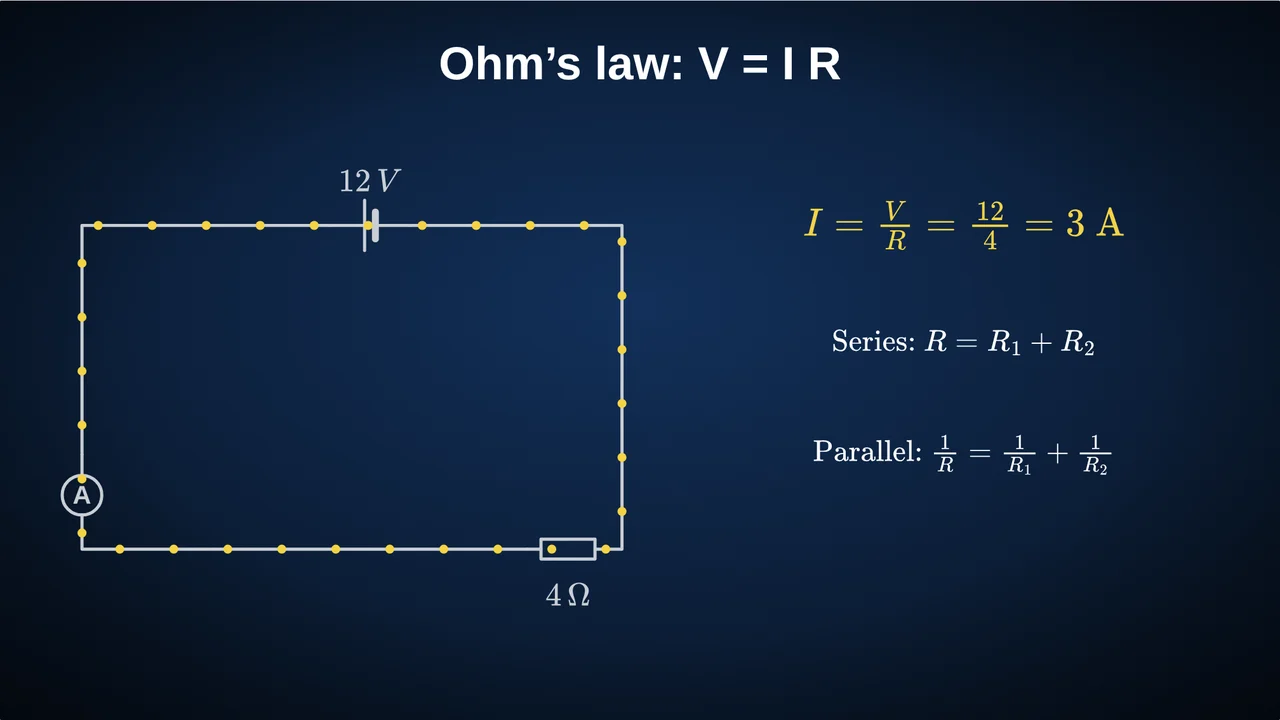
Ohm's law says the current through a resistor is proportional to the voltage across it: V = IR. A 12 V battery across a 4 Ω resistor drives a current of 3 A. With resistors in series the resistances add; in parallel the combination is smaller than either one.
Learning objectives
- Use V = IR to find voltage, current or resistance.
- Calculate the total resistance of resistors in series and in parallel.
- Explain why the current is the same everywhere in a series loop.
The opening question
"A bulb is connected to a battery. Is the current smaller after the bulb, because the bulb used some of it up?" Many students say yes. An ammeter before and after the bulb reads the same: the bulb uses energy, not current.
The lesson, click by click
- Click 0: a battery, a resistor and an ammeter in one loop, with the current flowing.
- Click 1: I = V/R = 12/4 = 3 A.
- Click 2: a second 4 Ω resistor in series: R = 8 Ω, so I = 1.5 A, and each resistor gets 6 V.
- Click 3: the two resistors in parallel instead: 1/R = 1/4 + 1/4, so R = 2 Ω and I = 6 A from the battery.
- Click 4: power, P = VI: the single resistor turns 12 × 3 = 36 W into heat.
Common mistakes to watch for
- Current is used up. In a series loop the current is the same everywhere; energy is transferred, not current.
- Parallel resistance adds up. Two resistors in parallel always give less than the smaller one.
- Voltage "flows". Voltage is across a component, between two points; current flows through it.
- Rearranging V = IR. I = V/R and R = V/I, not I = VR.
Check questions
- 9 V across 3 Ω: the current? (3 A.)
- 6 Ω and 3 Ω in parallel: the total resistance? (2 Ω.)
- A 2 A current through a 10 Ω resistor: the voltage across it? (20 V.)
Building it in Tracé
- Add an Electric circuit and list the parts around the loop, one per line:
battery: 12 V,resistor: 4 Ω,ammeter. - Tick Show the current flowing so the charges move around the loop while you present.
- Add a second resistor to the list on a click to move from one resistor to two in series.
Questions
Does Ohm's law apply to everything?
No. It holds for ohmic conductors, such as metal resistors at constant temperature. A bulb's filament gets hotter and its resistance rises; a diode barely conducts one way.
What is the water analogy?
Voltage is like pressure, current like the flow of water, and resistance like a narrow pipe. It helps, but don't push it too far.
When is this taught?
Usually around ages 13 to 16, with series and parallel circuits.
More: Physics animations for the classroom · How to create math slides, step by step