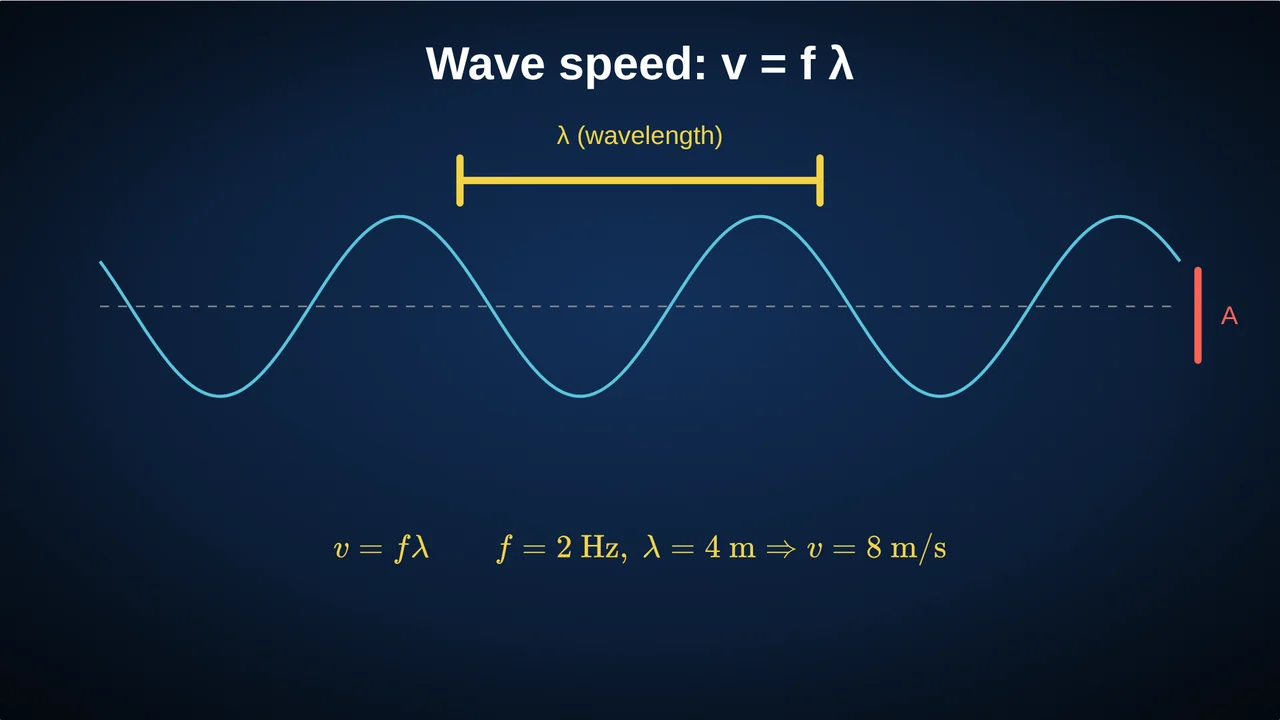
A wave moves one wavelength in one period, so its speed is v = fλ: frequency times wavelength. A wave with f = 2 Hz and λ = 4 m travels at 8 m/s. In a given medium the speed is fixed, so a higher frequency means a shorter wavelength.
Learning objectives
- Label wavelength, amplitude, frequency and period on a wave.
- Use v = fλ and T = 1/f.
- Apply them to sound and light.
The opening question
"A guitar plays a higher note. Does its sound reach you sooner?" No: all notes arrive together, at about 343 m/s in air. The higher note has a higher frequency and a shorter wavelength, at the same speed.
The lesson, click by click
- Click 0: a travelling wave, moving to the right.
- Click 1: the wavelength λ, crest to crest, and the amplitude A, rest line to crest.
- Click 2: watch one point: it goes up and down once per period T, while the wave moves forward one λ.
- Click 3: so v = λ/T = fλ. With f = 2 Hz and λ = 4 m, v = 8 m/s.
- Click 4: sound: 440 Hz in air (343 m/s) has λ ≈ 0.78 m. Light: an FM radio wave at 100 MHz has λ = 3 m.
Common mistakes to watch for
- Frequency changes speed. In one medium, raising f shortens λ; v stays the same.
- Amplitude changes speed. A bigger wave is not a faster one.
- Amplitude from trough to crest. That is twice the amplitude.
- The medium moves along. In a wave on a rope, each point moves up and down; the shape travels, not the rope.
Check questions
- A wave has f = 5 Hz and λ = 0.6 m. Its speed? (3 m/s.)
- Sound at 343 m/s with λ = 1.5 m. Its frequency? (About 229 Hz.)
- Period of a 50 Hz wave? (0.02 s.)
Building it in Tracé
- Add a Wave, choose Travelling, and set the Wavelength and Amplitude.
- Animate Phase (°), animate it to move the wave on a click, or let it loop so the wave keeps moving.
- Switch to Standing to introduce standing waves on a string.
Questions
What changes when a wave enters a new medium?
Its speed and wavelength change; its frequency stays the same, because it is set by the source.
What is the difference between transverse and longitudinal waves?
In transverse waves (light, a rope) the medium moves across the direction of travel; in longitudinal waves (sound) it moves back and forth along it.
When is this taught?
Usually around ages 14 to 16, and again in more depth in the last years of high school.
More: Physics animations for the classroom · How to create math slides, step by step