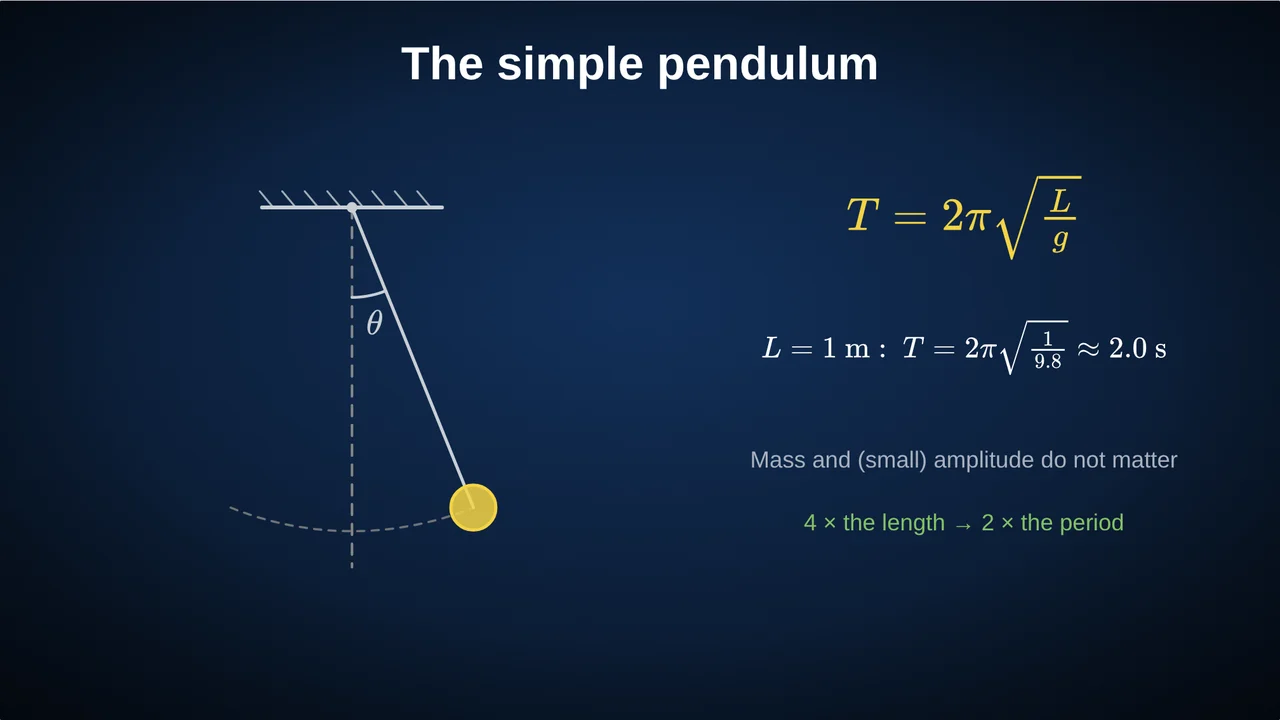
For small swings, a simple pendulum's period depends only on its length and on gravity: T = 2π√(L/g). A 1 m pendulum takes about 2.0 s per full swing. The mass does not matter, and neither does the size of a small swing, which surprises most students.
Learning objectives
- Use T = 2π√(L/g) to find a period or a length.
- Predict what changes the period (length, gravity) and what does not (mass, small amplitude).
- Plan an experiment to check the formula.
The opening question
"Two pendulums have the same length. One has a 1 kg bob, the other a 100 g bob. Which swings faster?" Most students pick the heavy one. They swing together: the formula has no mass in it.
The lesson, click by click
- Click 0: a pendulum swinging, with a timer counting full swings.
- Click 1: double the mass: the period stays the same.
- Click 2: four times the length: the period doubles, because of the square root.
- Click 3: on the Moon, where g = 1.62 m/s², the same 1 m pendulum takes about 4.9 s.
- Click 4: the limit: for large swings the period grows. At 15° it is only about 0.4% longer; at 60° about 7%.
Common mistakes to watch for
- Half swing versus full swing. The period is there and back, not one way.
- Length to the wrong point. L is measured to the centre of the bob.
- Expecting mass to matter. Gravity's pull and the bob's inertia both grow with mass, and cancel.
- Large angles. The formula comes from sin θ ≈ θ, which needs small swings.
Check questions
- Period of a 0.25 m pendulum? (2π√(0.25/9.8) ≈ 1.0 s.)
- What length gives a period of 2 s? (L = g(T/2π)² ≈ 0.99 m.)
- Timing 10 swings gives 20.1 s. Why time 10 instead of 1? (It divides the reaction-time error by 10.)
Building it in Tracé
- Add a Pendulum, tick Show the swing and Show the angle, and set it to loop so it keeps swinging.
- Change Length of the string on a click to compare two lengths side by side.
- Tick Show the forces (weight, tension) to explain where the restoring force comes from.
Questions
Why is it called simple harmonic motion?
For small angles the restoring force is proportional to the displacement, which gives sinusoidal motion, like a mass on a spring.
How was the pendulum used historically?
Pendulum clocks, from Huygens in 1656, were the most accurate clocks for nearly three centuries, because the period hardly depends on the swing size.
Can students measure g with it?
Yes: measure T for several lengths and plot T² against L. The slope is 4π²/g.
More: Physics animations for the classroom · How to create math slides, step by step