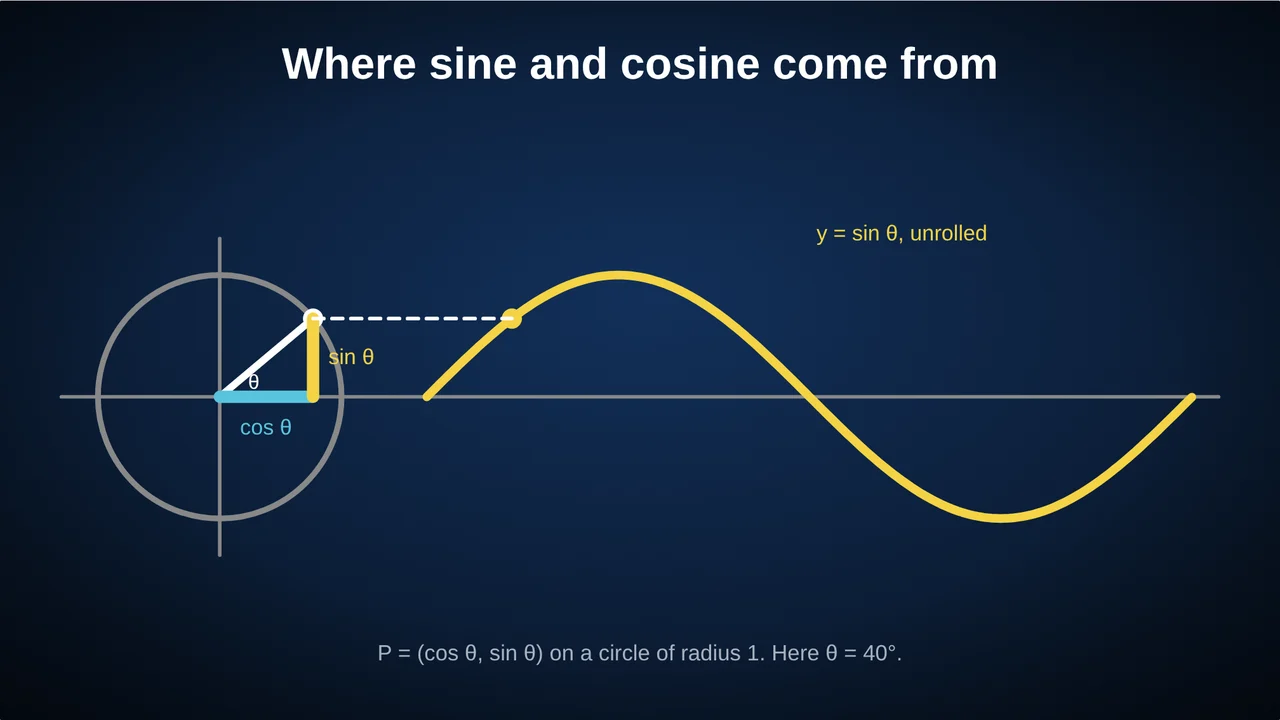
On a circle of radius 1 centred at the origin, the point at angle θ has coordinates (cos θ, sin θ). That one idea extends sine and cosine from triangles to every angle, explains their signs, and turns into the sine wave when the angle keeps turning.
Learning objectives
- Read cos θ and sin θ as the x and y coordinates of a point on the unit circle.
- Give exact values for 30°, 45°, 60° and the quadrant angles.
- Explain the sign of sine and cosine in each quadrant, and connect the circle to the graph of y = sin θ.
The opening question
Ask: sin θ is "opposite over hypotenuse". So what is sin 150°? A triangle can't have a 150° angle in that place. The unit circle is the answer: a definition that works for any angle and agrees with the triangle one for acute angles.
The lesson, click by click
- Click 0: the circle of radius 1 and a point at θ = 40°.
- Click 1: the right triangle inside: hypotenuse 1, so the horizontal side is cos θ and the vertical side is sin θ.
- Click 2: the point turns past 90° and 180°. The coordinates keep their meaning: in the second quadrant cos θ is negative, sin θ positive.
- Click 3: the special angles: 30° gives (√3/2, 1/2), 45° gives (√2/2, √2/2), 60° gives (1/2, √3/2).
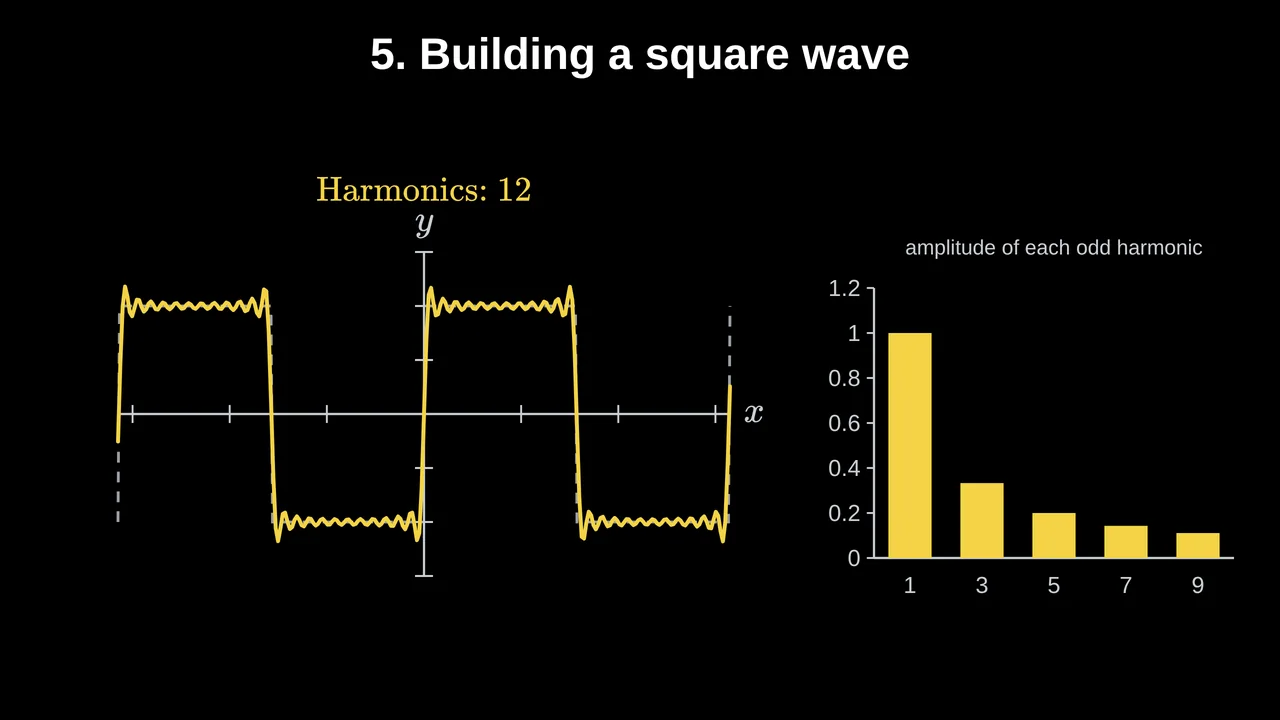
- Click 4: the height of the point is drawn against θ as the point turns: the sine wave unrolls.
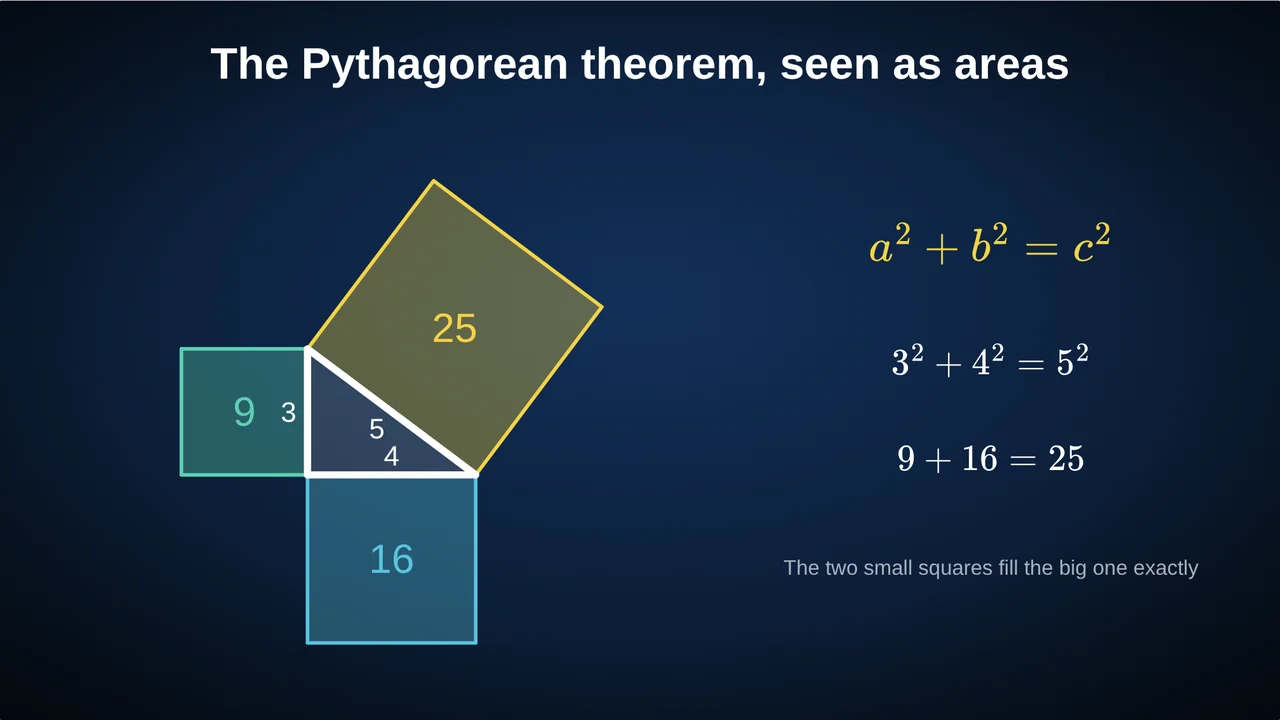
A bonus that links to Pythagoras: the triangle has hypotenuse 1, so sin²θ + cos²θ = 1 for every angle.
Common mistakes to watch for
- Swapping sine and cosine. Cosine is across (x), sine is up (y). "Cos comes first, like x" helps.
- Degrees versus radians. A calculator in the wrong mode gives sin 30 ≈ −0.99 instead of 0.5. A full turn is 360°, or 2π radians.
- Signs in the other quadrants. Students apply acute-angle values without the sign. Reading them as coordinates fixes this.
- Thinking sine needs a triangle. On the unit circle it is defined for any angle, including negative ones and angles above 360°.
Check questions
- What is sin 150°? (1/2: same height as at 30°, still above the x-axis.)
- What is cos 180°? (−1: the point is at (−1, 0).)
- In which quadrant are both sine and cosine negative? (The third, between 180° and 270°.)
Building it in Tracé
- Add a Custom animation with the angle growing over time:
let a = 2 pi u. - Draw the circle and the moving point:
circle (0, 0) radius 1andpoint P = (cos(a), sin(a)). - Add the cosine and sine as coloured segments, and the curve
y = sin(x)beside the circle, with a dot at height sin(a). - Set it to Held still: animate the time on clicks so each click turns the point to the next angle you want to discuss.
Questions
Should I teach radians at the same time?
Introduce them with the unit circle: θ in radians is the length of arc from (1, 0) to the point. A full turn is 2π because the circumference of a radius-1 circle is 2π.
How do students remember the special values?
For 0°, 30°, 45°, 60° and 90°, sin θ is √0/2, √1/2, √2/2, √3/2, √4/2, and cosine runs the same list backwards.
Where does this lead?
To graphs of sine and cosine, waves and oscillations in physics, and Fourier series, where sine waves build other shapes.
More: Animated math slides for teachers · How to create math slides, step by step