A Taylor series rewrites a function as a polynomial that matches it more and more closely: eˣ = 1 + x + x²/2 + x³/6 + x⁴/24 + …. Each new term fixes the error left by the previous ones. Five terms already give e¹ to within 0.4%.
The idea
Near x = 0, choose a polynomial with the same value, the same slope, the same curvature, and so on, as the function. The term in xn has coefficient f(n)(0)/n!. For eˣ every derivative at 0 is 1, which gives the 1/n! coefficients.
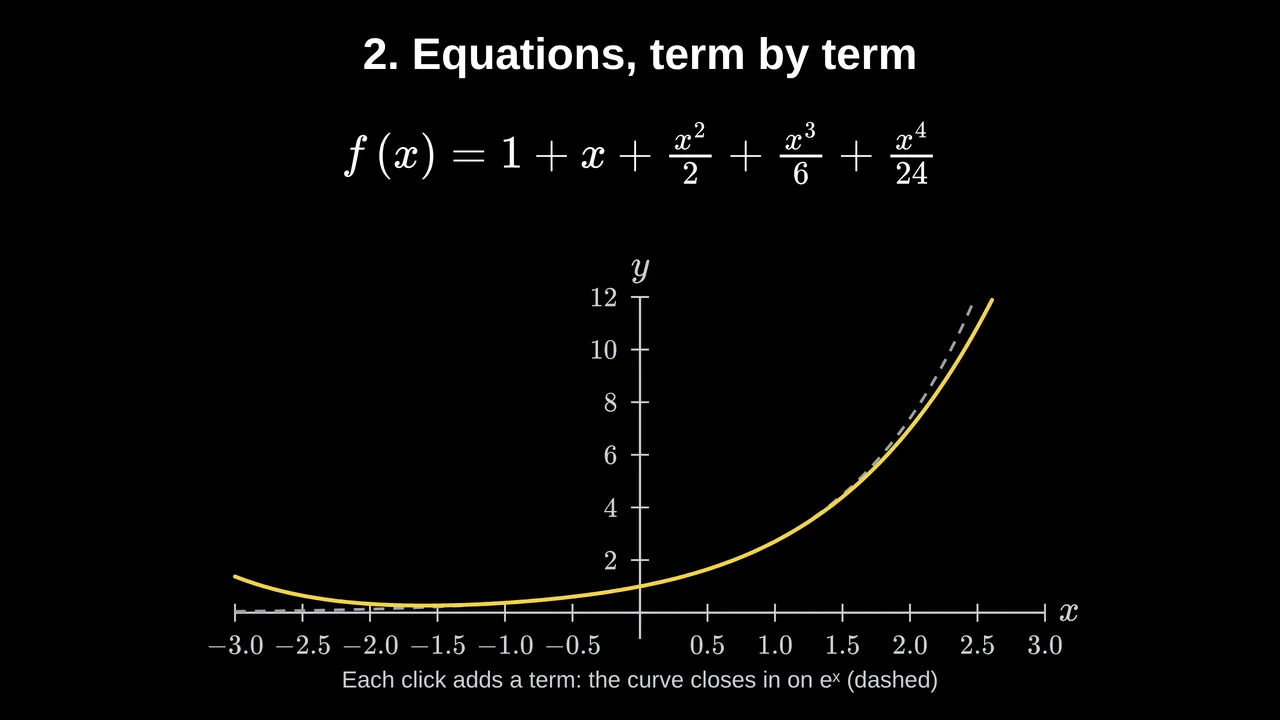
How good are a few terms?
| Terms used for e¹ | Value | Error |
|---|---|---|
| 1 + 1 | 2 | 0.718 |
| + 1/2 | 2.5 | 0.218 |
| + 1/6 | 2.667 | 0.052 |
| + 1/24 | 2.708 | 0.010 |
| + 1/120 | 2.717 | 0.002 |
The true value is e ≈ 2.71828. Close to 0 the approximation is excellent; far from 0 you need many more terms.
Sine and the small-angle approximation
For sine, only odd powers appear, with alternating signs: sin x = x − x³/6 + x⁵/120 − …. Keeping only the first term gives sin x ≈ x for small angles in radians. At x = 0.5, two terms give 0.47917 against the true 0.47943.
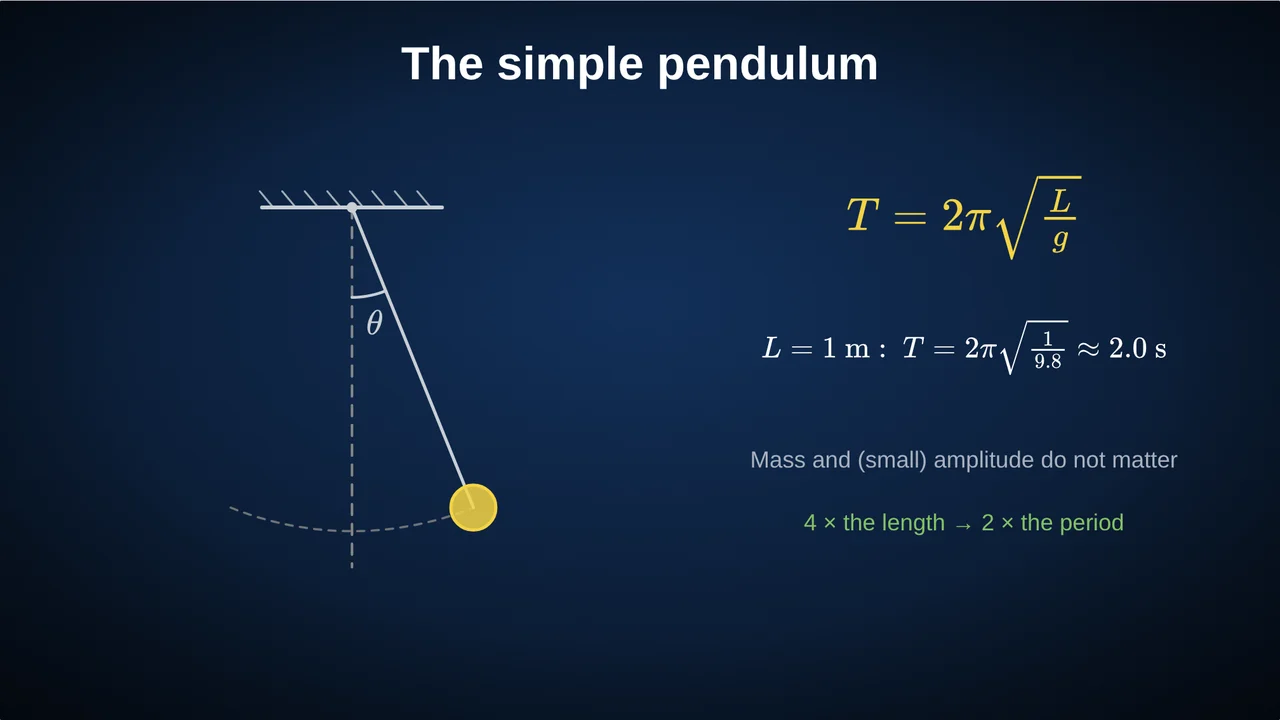
That approximation is what makes the pendulum formula T = 2π√(L/g) work: it is exact only for small swings.
Common mistakes to watch for
- Degrees instead of radians. sin x ≈ x only works with x in radians.
- Forgetting the factorials. The x³ term of eˣ is x³/6, not x³/3.
- Trusting it far from the centre. A few terms of a series around 0 can be badly wrong at x = 5.
Building it in Tracé
- Add a graph and set Curve to Fourier or Taylor series, then choose Taylor: eˣ (or sin x, cos x).
- Tick Show the exact curve, dashed.
- Animate Number of terms on clicks: 1, 2, 3, 4, 5. Each click adds a term and the curve bends towards the exact one.
Questions
What is the difference between Taylor and Maclaurin series?
A Maclaurin series is a Taylor series centred at 0. Taylor series can be centred at any point a, using powers of (x − a).
Do calculators use Taylor series?
Related ideas, yes: calculators and computers evaluate functions like sin and eˣ with carefully chosen polynomial or rational approximations, plus tricks to keep x small.
When is this taught?
In first-year university calculus, and in some final-year high school courses (AP Calculus BC, A-level Further Maths).
More: Animated math slides for teachers · How to create math slides, step by step