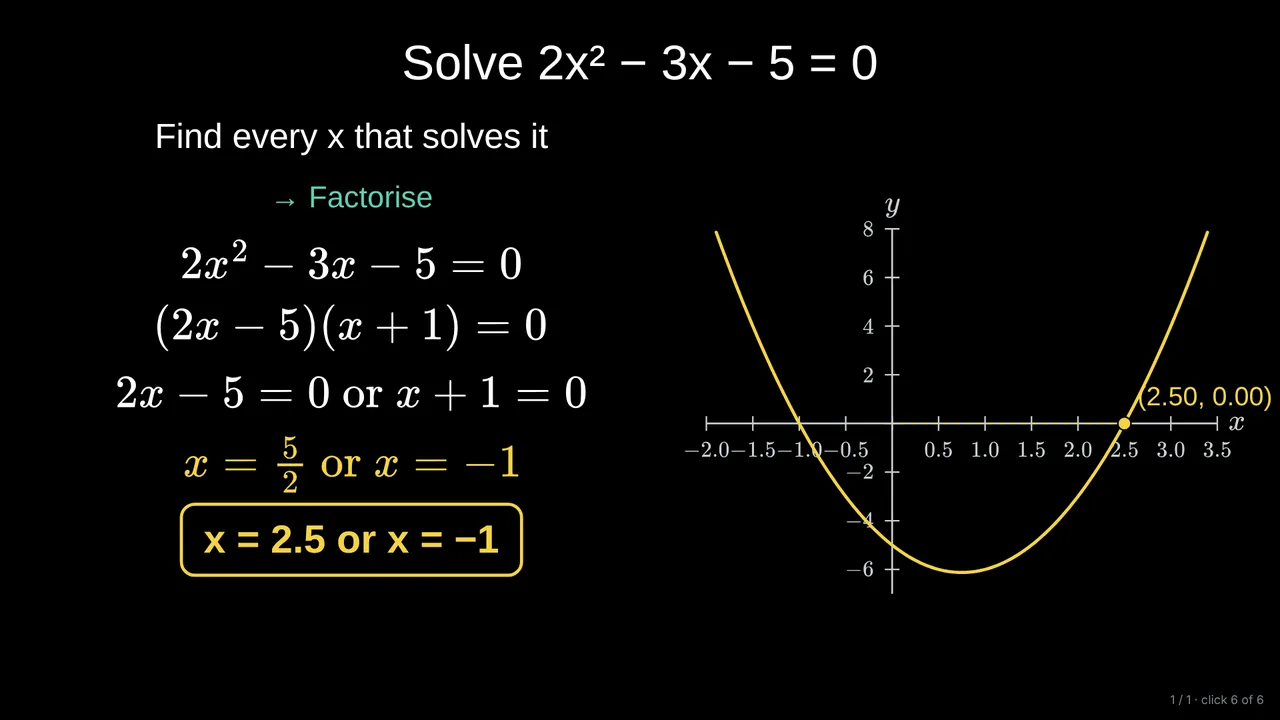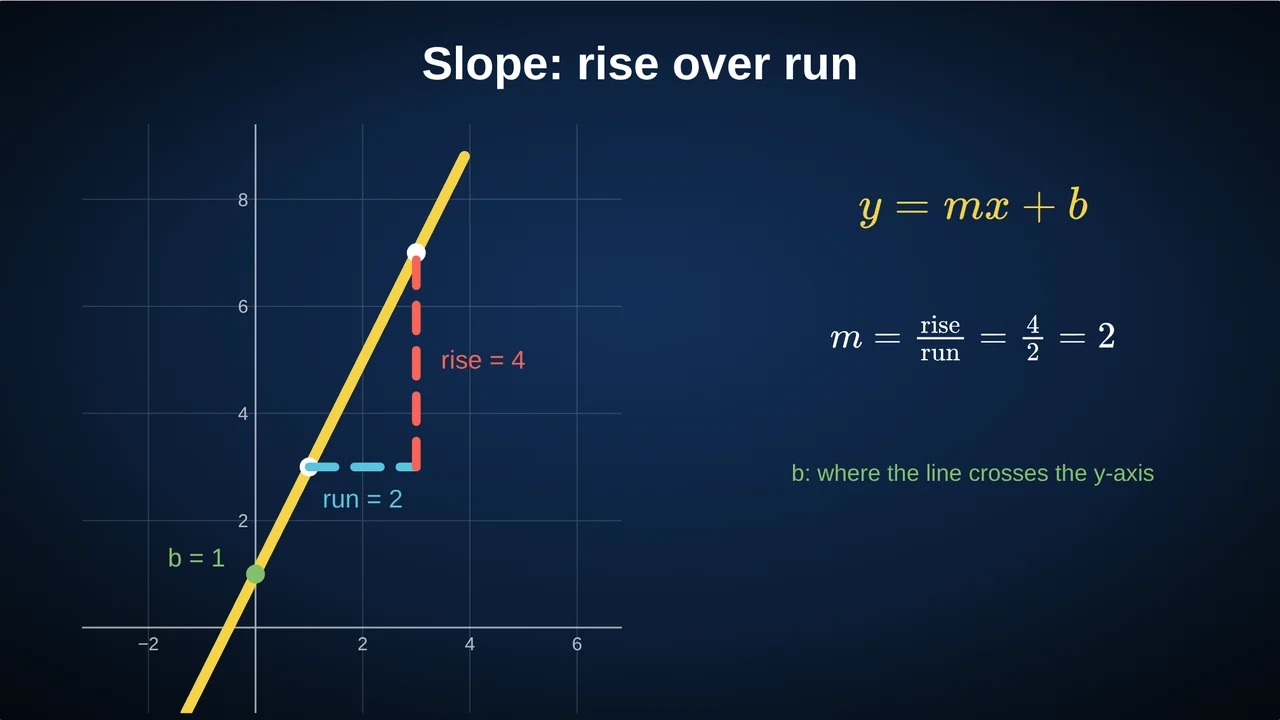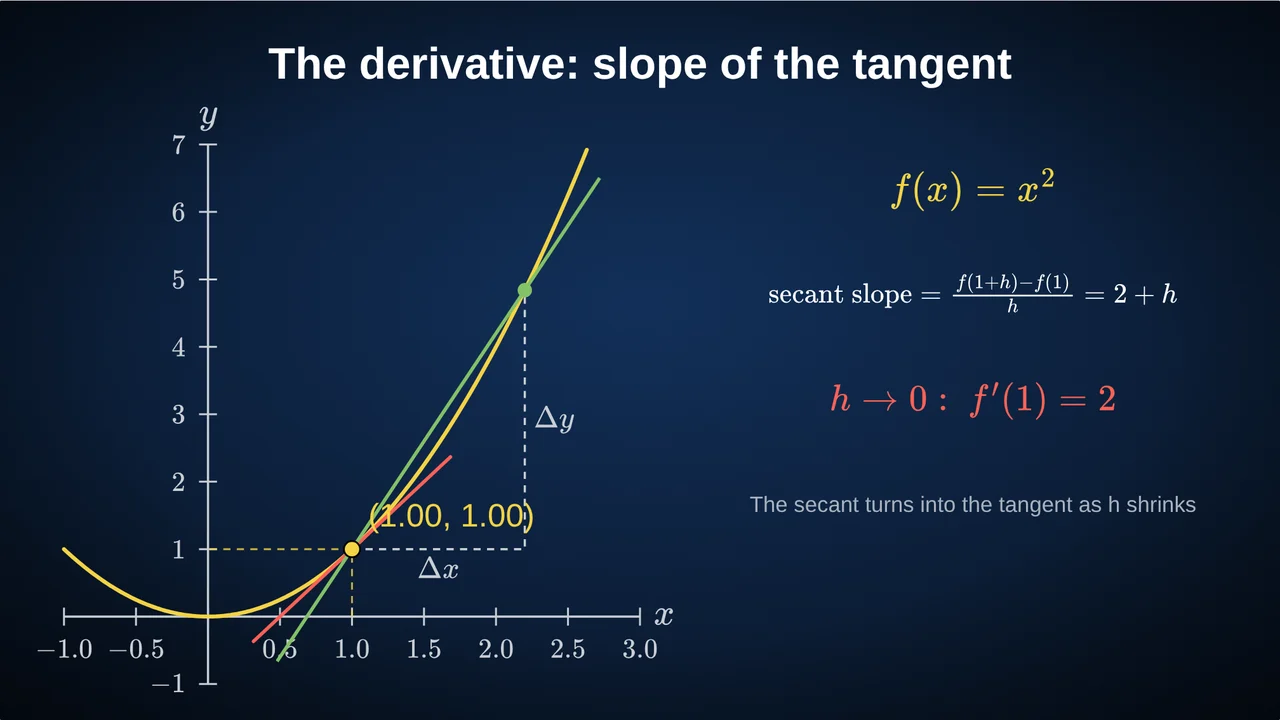
In vertex form, y = a(x − h)² + k, a quadratic tells you its turning point directly: the vertex is at (h, k). The number a says whether the parabola opens up or down and how narrow it is. Three sliders, one per letter, make each role obvious.
Learning objectives
- Read the vertex, the axis of symmetry and the direction of opening from vertex form.
- Describe the effect of a, h and k on the graph.
- Convert standard form to vertex form by completing the square.
The opening question
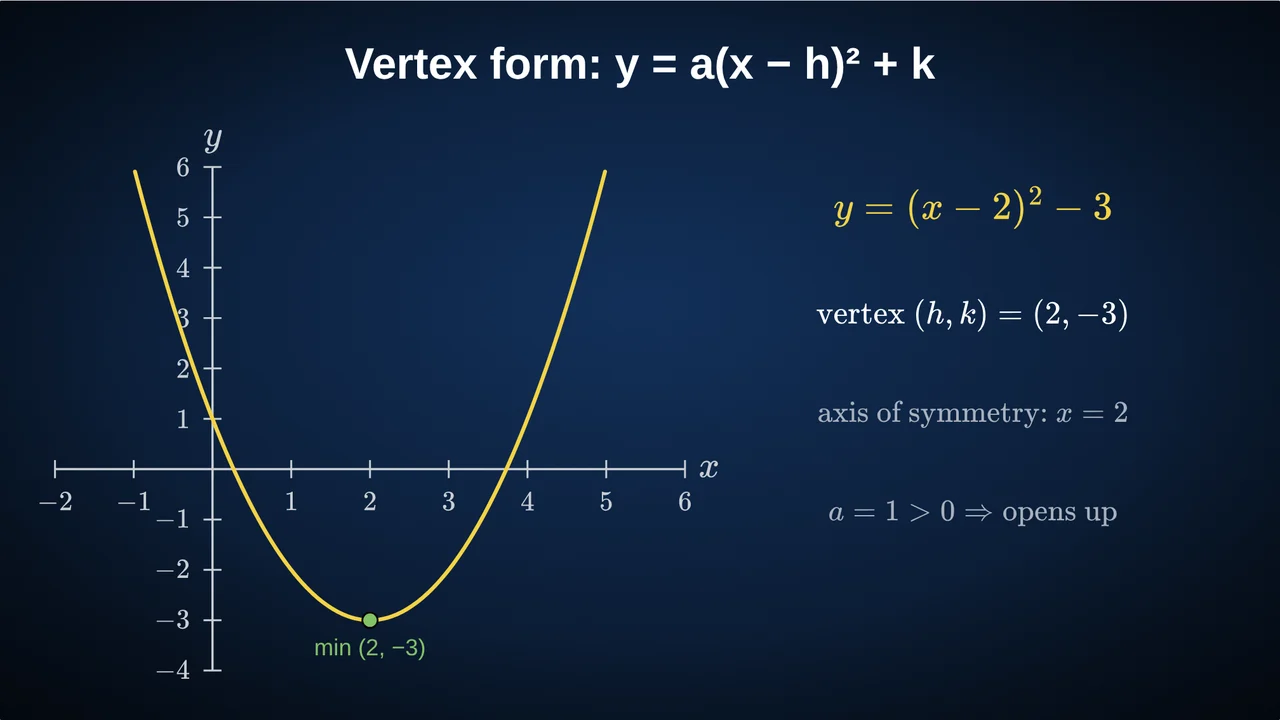
Show y = x² and y = (x − 2)² − 3 on the same axes: "What did the −2 and the −3 do?" Students often expect (x − 2) to move the graph left. It moves right, and explaining why is the heart of the lesson.
The lesson, click by click
- Click 0: y = x², vertex at the origin.
- Click 1, slider k: the parabola moves up and down; the vertex is at height k.
- Click 2, slider h: it moves sideways. (x − 2)² is zero at x = 2, so the lowest point is at x = 2: a right shift.
- Click 3, slider a: bigger |a| is narrower; negative a flips it upside down, and the vertex becomes a maximum.
- Click 4: from standard form, y = x² − 4x + 1 = (x − 2)² − 4 + 1 = (x − 2)² − 3.
Common mistakes to watch for
- The sign of h. In (x + 3)², h = −3, so the shift is left.
- Forgetting to subtract when completing the square. x² − 4x = (x − 2)² − 4, not (x − 2)².
- a outside the square. 2(x − 1)² is not (2x − 2)², which equals 4(x − 1)².
- Vertex versus intercept. The y-intercept is the value at x = 0 (here 1), not k.
Check questions
- Vertex and direction of y = −2(x + 1)² + 5? ((−1, 5), opens down, maximum value 5.)
- Write y = x² + 6x + 2 in vertex form. ((x + 3)² − 7.)
- Where does y = (x − 2)² − 3 cross the x-axis? (x = 2 ± √3, about 0.27 and 3.73.)
Building it in Tracé
- Type
y = a (x - h)^2 + kand press Plot this equation as a graph. - Tick Live slider for a, h and k, and Mark the maxima and minima so the vertex is labelled as it moves.
- Show the sliders one per click, in the order k, h, a.
Questions
Why is vertex form useful?
It gives the maximum or minimum straight away, which is what most applied problems ask: the highest point of a ball, the lowest cost, the best price.
How do I find the vertex from standard form quickly?
For y = ax² + bx + c, the vertex is at x = −b / (2a). Substitute to get its height.
When is this taught?
In Algebra 1 or 2 (ages 14 to 16), alongside factoring and the quadratic formula.
More: Animated math slides for teachers · How to create math slides, step by step