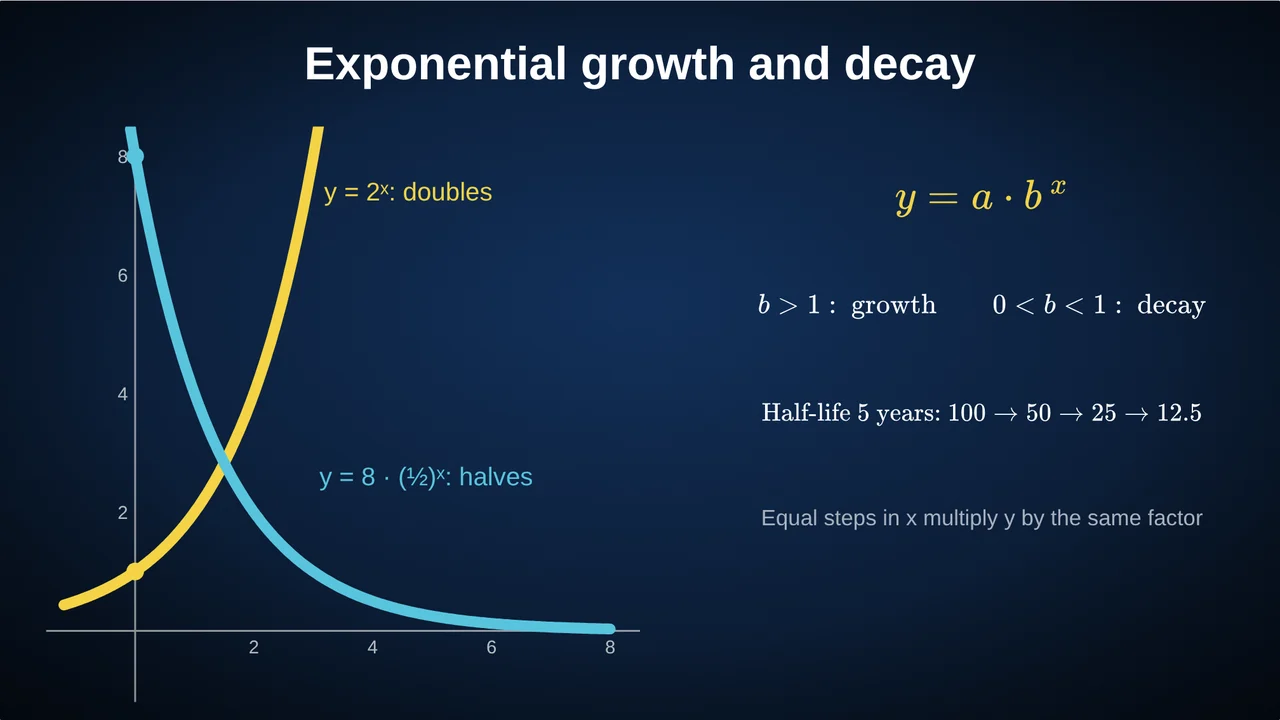
An exponential function multiplies by the same factor at every step: y = a · bˣ. If b > 1 it grows (doubling, compound interest); if 0 < b < 1 it decays (half-life, cooling). The contrast with linear growth, which adds the same amount each step, is the key idea of the lesson.
Learning objectives
- Recognise exponential growth and decay from a table, a graph or a story.
- Write y = a · bˣ from a starting value and a growth or decay factor.
- Solve problems with doubling time, half-life and compound interest.
The opening question
"Would you rather have €1,000 a day for 30 days, or 1 cent on day 1, doubled every day for 30 days?" The doubling pays 2²⁹ cents on day 30 alone: over €5 million. Students rarely guess it.
The lesson, click by click
- Click 0: a table for y = 2ˣ: 1, 2, 4, 8, 16. Each step multiplies by 2.
- Click 1: the graph: slow at first, then very steep.
- Click 2: decay: 8 · (½)ˣ halves each step, 8, 4, 2, 1, and never reaches 0.
- Click 3, half-life: 100 g of a substance with a half-life of 5 years: 50 g after 5 years, 25 g after 10, 12.5 g after 15.
- Click 4, compound interest: €1,000 at 5% a year for 10 years: 1,000 × 1.05¹⁰ ≈ €1,628.89.
Common mistakes to watch for
- Adding instead of multiplying. 5% growth is × 1.05 each year, not + 5% of the starting amount every year.
- 2ˣ versus x². At x = 10, 2ˣ = 1,024 while x² = 100. Exponentials win in the end.
- Decay factor. A 20% decrease is × 0.8, not × 0.2.
- Expecting decay to reach zero. Halving forever gets closer and closer to zero without reaching it.
Check questions
- Bacteria double every 20 minutes, starting from 100. How many after 2 hours? (6 doublings: 6,400.)
- A car worth €20,000 loses 15% a year. Its value after 3 years? (20,000 × 0.85³ ≈ €12,283.)
- Which grows faster in the long run, 100x or 1.1ˣ? (1.1ˣ, eventually.)
Building it in Tracé
- Type
y = a b^xand press Plot this equation as a graph. - Tick Live slider for a and b, and drag b across 1: growth turns into decay.
- For large values, tick Logarithmic vertical axis (powers of 10): exponential growth becomes a straight line.
Questions
Where does e come in?
e ≈ 2.718 is the base for growth that is continuous rather than step by step, as in continuously compounded interest or radioactive decay: N = N₀e^(−λt).
When is this taught?
Usually in Algebra 1 or 2 (ages 14 to 17), and again with logarithms.
How do logarithms relate?
They answer "how many steps?": to find when 2ˣ reaches 1,000, solve x = log₂ 1000 ≈ 9.97.
More: Animated math slides for teachers · How to create math slides, step by step