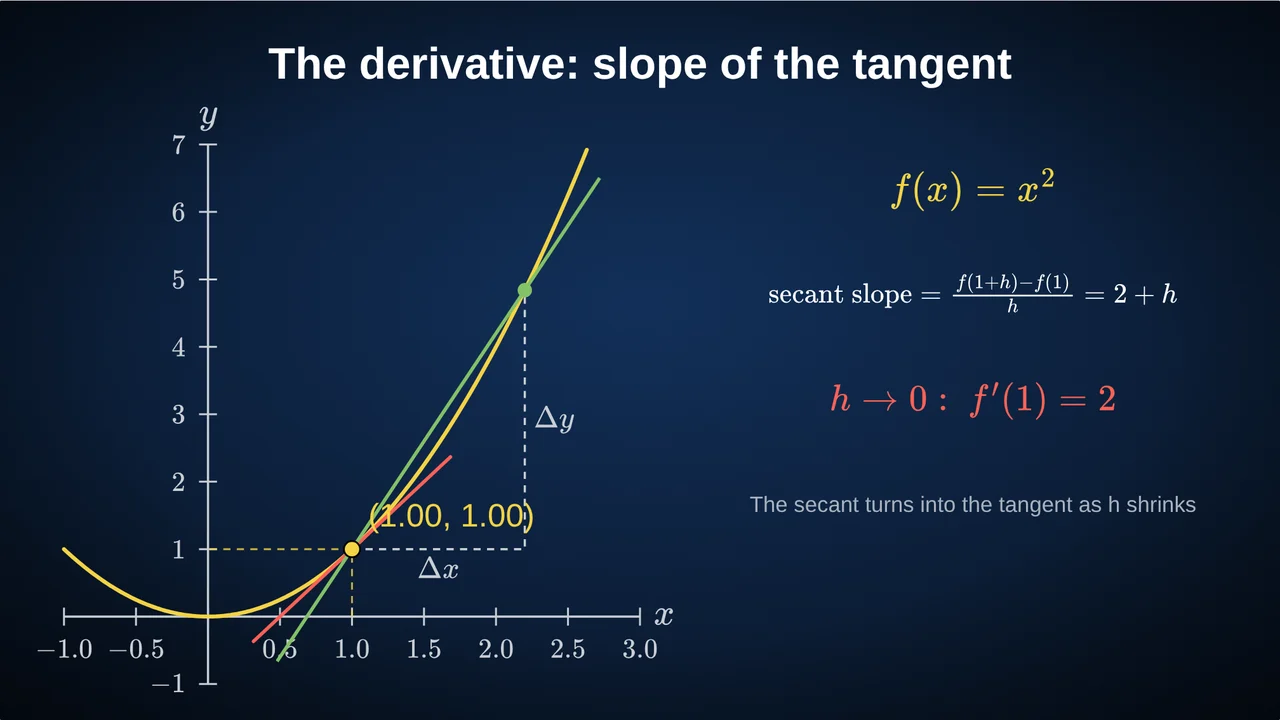
The derivative of a function at a point is the slope of its tangent line there. To find it, take a secant line through two nearby points and slide the second point towards the first: the slopes approach a limit. For f(x) = x² at x = 1, the secant slopes are 2 + h, which tend to 2.
Learning objectives
- Describe the derivative as the slope of the tangent and as an instantaneous rate of change.
- Compute secant slopes and see them approach a limit.
- Use the definition f′(x) = lim (f(x + h) − f(x)) / h for a simple function.
The opening question
"A car's speedometer says 50 km/h at exactly 3 pm. Over what time interval was that speed measured?" The answer, "none, it's the speed at an instant", is the idea of a derivative. Average speed over a shrinking interval is a secant slope over a shrinking h.
The lesson, click by click
- Click 0: y = x² and the point (1, 1).
- Click 1: a secant to (1 + h, (1 + h)²) with h = 1: slope (4 − 1)/1 = 3.
- Click 2: h shrinks to 0.5, 0.1, 0.01: slopes 2.5, 2.1, 2.01.
- Click 3: the algebra, ((1 + h)² − 1)/h = (2h + h²)/h = 2 + h, which tends to 2.
- Click 4: the tangent line, y = 2x − 1, and the general result f′(x) = 2x.
Common mistakes to watch for
- Setting h = 0 too early. (f(1 + 0) − f(1))/0 is 0/0. Simplify first, then let h shrink.
- Tangent means "touches once". A tangent can cross the curve elsewhere, and at an inflection point it crosses at the point itself.
- Derivative versus value. f′(1) = 2 is a slope; f(1) = 1 is a height.
- (1 + h)² = 1 + h². The missing 2h is the whole answer.
Check questions
- Slope of the secant of y = x² from x = 1 to x = 3? ((9 − 1)/2 = 4.)
- Derivative of f(x) = 3x + 2? (3, everywhere: a line is its own tangent.)
- Slope of y = x² at x = −1? (−2: the curve is going down there.)
Building it in Tracé
- Plot
y = x^2, tick Mark a point on the curve and set Point at x = 1. - Tick Secant line from the point (animate Δx → 0) and set Secant Δx to 1.
- Add clicks where Δx becomes 0.5, then 0.1: the secant swings smoothly towards the tangent.
- Finish with Tangent line at the point, and a Slider for the point while presenting to move along the curve.
Questions
When is the derivative introduced?
Usually in the last years of high school (AP Calculus, A-level, lycée première), around ages 16 to 18.
Should I teach limits formally first?
An intuitive limit, watching the secant slopes settle, is enough to start. Formal ε–δ limits can come much later.
Where does it lead next?
To derivative rules, maxima and minima, rates of change in physics (velocity, acceleration), and Newton's method.
More: Animated math slides for teachers · How to create math slides, step by step